Numbers and Feelings

November 5, 2017

How do numbers feel to us? Numbers are hard like rocks. Feelings are squishy. Numbers are left-brained. Feelings are right-brained. Deep in the vaults of our brains, tiny elves translate one into another. Here’s an example.

This past week, House Republicans released an initial proposal of tax reform. A feature of the plan is the limitation of state and local tax deductions (SALT) to $10,000. Under current tax law, taxpayers have been able to deduct state and local taxes without limit.

This will hurt taxpayers in high-tax blue states which are overwhelmingly Democratic. Wisconsin, a purple state, is the lone exception among the top ten states (Forbes ranking of state tax burden).

Expecting no votes from Democrats in passing a tax reform/cut bill, Republicans included few provisions in the bill that would pacify voters in Blue Democratic states. Republican congresspersons in those states are faced with a dilemma. One Republican congressperson in New Jersey, one of the top high tax states, claimed that the average SALT deduction in his district was $21,000, more than double the allowance in the tax reform proposal.

Knowing that the SALT limitation will hurt their constituents, do Republican House members vote with their party or in the interests of their constituents? Numbers can make politicians anxious.

For some taxpayers in those states, the feeling is anger. “I don’t want to pay taxes on my taxes,” one New Jersey resident growled.

That same N.J. congressperson claimed that incomes less than $200,000 were middle-class. According to this calculator based on the Census Bureau’s Current Population Survey, an income of $200K is in the 97th percentile of all incomes. Less than 3% of households have incomes greater than $200K. Hardly middle-class.

What is middle class? Some studies use the 25th – 75th percentile. Some use the 30th – 80th percentile. Using the latter definition, 2016 incomes from $24,000 to $75,000 were considered middle-class. These classifications use national data. Many coastal states have far higher incomes and living costs.

People living in some east and west coastal states feel middle class even though the income numbers do not classify them as such. Take for example, a household in Silicon Valley, where the median household income is almost $100K,  $40K more than the national median. They are rich, right?

Not so fast. The median price of a home in Santa Clara County (San Jose) is almost $1.2 million (See here ). Spending $40,000 annually for housing on an income of $95,000 feels middle class. The percentage of housing cost to income, 42%, is far higher than the 30% HUD guideline, and is more typical of poor working-class families.

Californians have counties with the highest incomes in the U.S. – and some of the poorest. The state has a median household income that is 12% higher than the national average.

CalUSHouseholdIncComp

But that’s not how it feels. That extra income is eaten up by higher housing costs, high car insurance premiums, and higher taxes at all levels. California sends about 12% more taxes to Washington than it gets back in various national programs. The additional federal taxes paid by higher income coastal states helps pay for benefits to those in lower income states, particularly those in southern states. Blue states subsidize Red states.

The Red states control the national agenda in Washington. The Republican tax proposal in its current form takes tax pebbles from the Red scale and puts them on the Blue scale. That feels spiteful.  Voters in those Blue states feel angry.

Interest groups around the country feel angry. The National Association of Home Builders claims that the SALT limit will lower home valuations, particularly in coastal states. They have promised a considerable effort and expense to defeat this version of the tax proposal.

When I recalculated my family’s 2016 taxes using the new proposal, we saved $752, a bit less than the $1200 average savings for a family of four. The monthly tax savings – the numbers – are relatively small. I feel neither angry or joyful. Those of us who are little affected by the proposal are unlikely to raise our voices in protest or support.

Angry people act. They call, they shout, they organize.

Joyful people – the CEOs of large corporations who will benefit greatly from this proposal – are not shouting. They calmly make claims that lower taxes will create more jobs, although the evidence is rather weak. They are organizing. They are calling talk shows. But most of all they are donating.

Political donations can speak more loudly than the shouts of angry people. In the political game of Rock, Scissors, Paper, cash covers a rock thrown in anger. Angry people must take up the more precise and patient tool of the scissors if they hope to best cash in a contest.

Lastly, this tax proposal further divides earners into groups. Income earners above the median will learn that this $1 is not the same as that $1 to the taxman.  According to an analysis done for the Wall St. Journal,
The $1 earned in wages and salary will be taxed more than
The $1 earned by the small manufacturer, which will be taxed more than
The $1 earned by the real estate investor, which will be taxed more than
The $1 earned by a stock or bond investor, which will be taxed more than
The $1 paid to an inheritor, who will pay $0.

Republicans criticize the identity politics practiced by Democrats. With this tax proposal, Republicans have stamped identities on the very $$$$ we earn. Those numbers don’t feel good.


A Graduated System of Benefits

October 29, 2017

My kids will learn that they are the sons and daughters of charity parents.

Two weeks ago, I wrote about the measurement of the poverty rate in America. Why is our standard different than the one adopted by all other developed countries? What efforts have we made to alleviate poverty, and have those programs helped or hurt the poor?

Qualifications for benefits under various programs rely primarily on paid income. As a person exceeds certain thresholds of income, benefits are reduced or stopped entirely. Regardless of how we define a reduction in benefits, it feels like a tax to the recipients. Under these programs, the poor pay the highest tax – 100%. $1 earned above a certain threshold results in a $1 reduction in benefits. There is a very real incentive to hide reported income.

As I showed earlier, the poverty standard adopted by the U.S. undercounts the number of poor. On the other hand, income earned in the underground economy is not counted and results in an overcount of the poor.

We may associate “underground” with “illegal” but it includes both legal and illegal activities. A better synonym would be “unreported.” Workers in the unreported economy may include the kid down the block who mows our lawn, the guy who repaired our fence, the woman who walks our dog when we work late.

Almost all of us are part of the unreported economy whether we realize it or not. Recent estimates of the size of this shadow economy in the U.S. are from 7% to 11%. In dollar amounts, that’s $1.4 trillion to over $2 trillion. In less developed economies, it can be as much as 25%.

The tragedy of current programs is that they often discourage recipients from getting more work, or better paid work. The loss of Medicaid benefits dissuades a single mom with children from taking on employment unless she can find an employer who provides health insurance for her and her children. Many don’t.

Income above a certain threshold may disqualify someone from housing benefits. Under a Section 8 housing program, a low-income person pays 30% of their monthly income for housing (Section 8 FAQs). HUD, a Federal agency, and state agencies pay the rest of the rent. Section 8 housing is in short supply. The amount of paperwork and inspections required by HUD dissuades many real estate owners from enrolling their properties in the program.

These programs would improve by paying benefits on a graduated scale rather than using a qualifying threshold. Under the current system, a person making less than half the area’s median income, let’s say $24,000, gets housing assistance and other benefits. If they make above that, they may receive nothing under some Federal and state programs. That is the equivalent of a 100% – or higher – tax.

This graduated scale should apply to everyone. That includes the richest people on the planet like Bill Gates and Warren Buffett, who would also be eligible for housing vouchers, food stamps, for supplemental income and Medical benefits. As income increased, benefits would be gradually decreased. Bill Gates would be eligible for housing assistance, but his monthly benefit would be $0. For many of us, there would be no incentive to apply.

A graduated scale would help eliminate the quiet shame that some people experience when they receive public assistance. Like it or not, there is a stigma attached to being poor and receiving benefits.

A person with a disability can receive Social Security and Medicare. They can be quick to point out the fact. They are not on SSI, a program for low-income people. They are on Social Security. They paid into the insurance system. They got hurt. They are collecting on the insurance payments they made during a lifetime of work. Because they are disabled, they are on Medicare, not Medicaid. Medicaid is for poor people. If they are poor, it is only because they became disabled.

If I am a worker with a family to support and I make $11 per hour, or about $450 a week, my family is qualified to receive housing, food, medical and other assistance programs. I may be experienced in a few construction trades, but my tools were stolen last year. Perhaps I don’t have reliable transportation. I could make more money if I could get some tools or a more reliable car, but I can barely take care of my family. How can I get ahead?

A concrete contractor offers me a job paying $20 an hour for a project that will last the summer months for sure. However, the winter months may be a bit lean. The additional income will put me over the income threshold and my family will lose most of the benefits.

If I calculate the benefit my family currently receives in addition to my current $11 per hour wage as a janitor, I am receiving the equivalent of about $20 an hour. Even though I prefer to take the new job, I should continue to work at my current job for the sake of my family. Perhaps I can find a few jobs on the side, or “under the table,” but these are sporadic.

If I continue to stay out of the construction trades, my skills will atrophy. My self-confidence will erode. My kids will learn that they are the sons and daughters of charity parents.

The example above is all too common. If we had a gradual system of benefit awards, such a worker would be more inclined to take that better paying job. With a higher income, they might be able to get a loan for more reliable transportation. Their family might be able to afford more housing choices.

Who benefits under the current system? Whenever a poorly performing system stays in place, there is usually a small group of people who benefit under that system. They don’t want it to change.

Am I being a bit too cynical? No. It is Realpolitik. The practical benefits for one group of people outweigh any moral considerations by that group. In a later blog, I’ll look at who benefits from the current system.

Sacred Cow

October 22, 2017

Moo. One of the sacred cows of tax law has been the mortgage interest deduction. There is talk that the proposed Tax Reform law will erase this deduction. Who benefits from the deduction? Before I look at that, here’s some groundwork.

Two months ago the IRS released aggregated income tax data for 2015. Pew Research analyzed the data and produced this  chart of who pays how much in individual income taxes.   I took the liberty of marking up  their chart.

TaxAnalysis2015Pew

The Tax Reform bill that is being tortured to death in the back rooms of Congress proposes to double the standard deduction, making the first $50K that a couple earns tax-free. About 50% of tax returns will pay little or no federal income tax. That leaves the other half to pick up the tab for the 5% of taxes paid by the lower half of incomes. 1% of tax returns paid 40% of taxes in 2015 and they will argue that they are already paying their fair share.

As the Congress tries to craft a Tax Reform bill, one of the hot button topics is the mortgage interest deduction. According to IRS analysis of 2015 tax data, 33 million returns, about 20% of total returns, took the mortgage interest deduction totaling $304 billion, averaging over $9000, or $770 a month. The annual cost to the Treasury is about $70 billion in taxes not paid.

The bulk of this tax giveaway goes to wealthy families, but the program is popular among middle class families in expensive housing markets, particularly on the east and west coasts. The Tax Reform package proposes to double the standard deduction.  For many married couples, this would exclude another $25K of their income. This $25K is far more than the $9K average mortgage interest deduction.  However, there will be about 8 million returns, mostly wealthier Americans, who will pay more.  Those 8 million will certainly raise a campaign of alarm and outrage as they try to convince the vast majority of Americans that this reform is so un-American. Those in the real estate sector will claim that this will cripple a recovering homebuilding sector and prevent many American families from owning a home.  It won’t.  Each sector of the economy wants to preserve their tax carve outs because their business model has come to depend on it.

Notice that the analysis included effective, not marginal, tax rates. What is the difference? The effective rate is the net tax divided by adjusted gross income. It is the average tax paid for all the income received. For those who use tax preparation software, the program calculates the effective rate and prints it out on the summary page.

The marginal rate is the highest tax rate paid on the last dollar. When we hear someone complain that they are in the 33% tax bracket, for example, we think that the person pays 33% on all their income. They don’t. A two-earner family making $130K, filing jointly, two deductions, would be in the 25% bracket in 2017, but their effective tax rate is 12.89%, almost half of the marginal rate. (Dinky Town calculator)

Why is this important? Let’s return to the difference between effective and marginal tax rates. Let’s say our hypothetical couple making $130K wants to buy a new house for $300K. After $60K down, they will pay about $7800 per year in interest for the first 20 years of a 30-year mortgage (Zillow mortgage calculator). What they tell themselves is that they are “saving” over $160 per month, almost $2000 per year, because they are in the 25% tax bracket.

What is the fallacy? The couple assumes that the first dollars they earn buy the groceries, buy clothes for the kids, or make the car payment. It’s the last money earned, the money that is taxed at a 25% rate, that they will use to pay the mortgage. It’s sounds silly, but it’s effectively what we do when we use the marginal rate to analyze costs. Real estate salespeople sometimes use this technique to upsell a couple into a more expensive house, one that earns the salesperson a higher commission. If our couple uses the effective tax rate of less than 13%, the savings on that monthly mortgage payment is only $83. Many financial decisions are made “at the margin” but this is not one of them.

Also on the cutting board is a reduction in the amount of pre-tax contributions a person can make to a 401K retirement program.  Higher income earners would be trading in that tax break for lower tax rates, but the finance industry is sure to balk.  They make billions of dollars in administrative and trading fees for these retirement programs. In addition to the taxpayers who receive the benefits directly, tax breaks have protectors who benefit indirectly from the break. Together, this minority fights for their interests.

Soon after the last tax reform was passed in 1986, members of Congress began adding tax exclusions. Republicans may be able to pass a reform bill under a Budget Reconciliation rule in the Senate, which requires only a 50-vote threshold. Their slim majority in the Senate and a lack of cooperation from Democrats means that passage of a reform bill is vulnerable to just a few Republican defections. This is how health care repeal or reform was defeated earlier.  It can happen again.

The Poor and the Not Poor

October 15, 2017

No worries. Among the 25 OECD countries, Americans have historically had the lowest percentage of their financial assets in cash and savings deposits. After the financial crisis, we became the second lowest, just ahead of Chile. The percentage for the most recent available year (2015) was 13.5%.

In the heady optimism of the dot-com boom in 1999-2000, Americans had less than 10% of their assets in cash and savings. In the long downturn from 2000 – 2003, Americans bumped up their percentage in safe assets to almost 13%. As the economy recovered, that need for safety declined slightly but not to the levels of the 1990s. The financial crisis in 2008 caused Americans to reach for safety. Safe assets rose to 14.3% of total financial assets and we have still not recovered the level of confidence we once had.

You can click on this OECD link to see a comparison of current percentages. On the bottom right below the chart you can drag the year slider and look at some historical data.

Below the chart on the left is a category labeled “Perspectives.” Select “Total” to see total financial assets, which does not include home equity. Americans have the second highest total, just below Switzerland.

On the other hand, the U.S. has a comparatively high poverty rate of 17.5% using the OECD standard,  a simple measure that an economist would use.The poverty threshold is half the median income.

The U.S. publishes a poverty rate that is several percent lower because it uses a complex definition first set in 1963 when families spent an estimated 1/3 of their income on food. The complexity of the definition hints that politicians had a hand in crafting the definition but it is attributed to one person in the Social Security Administration, who based her standard on a combination of foods that the Department of Agriculture thought would meet minimum nutritional needs. The history of this standard and its many revisions is an interesting read.

The threshold is set at three times the cost of this 1960s era minimum food diet. Efficiencies in food production over the past 50 years have dramatically lowered food costs for U.S. families. In 1978, the BLS estimated that the average family spent only 18% of their income on food. In 2014, it was a bit more than 14% (BLS).

Using food costs as the basis for measuring poverty has enabled politicians in this country to claim success in lowering poverty over the past half century. In 1978, the calculation of the U.S. poverty threshold produced one that was slightly more than the OECD standard. Today, the U.S. threshold is 16% less than the OECD standard.

Let’s look at a family of four making $28K in 2016. They were above the official U.S. poverty threshold of $24,300 for a family of four. By the OECD definition, that American family was below half of the median $59K in income and would be counted as poor.

Housing costs are higher in urban areas, where half of the U.S. population lives. That family of four living in Chicago might pay $15000 per year for a 2 BR apartment in Chicago. Further south in the same state, Springfield, IL, they might pay $11,000. That $4000 difference in housing cost is not calculated into the poverty rate that the U.S. publishes. In effect, poverty is undercounted in urban areas and overcounted in rural areas.

The simplicity of the OECD standard better captures poverty among both urban and rural low-income families because it is based on median income. So why doesn’t the U.S. adopt this much clearer standard? We can turn to the last sentence of the previous paragraph for a clue. Politicians in rural areas want a standard that overcounts poverty in their districts. A higher headcount of poverty equals more subsidies for their constituents. When this standard was set, rural areas in the southern states were primarily Democratic and Democrats dominated the Congress under a Democratic President, Lyndon Johnson. Those politicians wanted the adoption of a food based standard that overcounted those voters.

Today, most rural areas are predominantly Republican and the standard works to the advantage of Republicans and the disadvantage of Democrats. As a rule of thumb, whenever we see excessive complexity in rule-making, there’s usually a very sound political reason for that obfuscation. Former President John Adams lamented this unfortunate characteristic of lawmaking in the crafting of the Constitution itself.

The intentional lack of clarity in lawmaking ensures that any nation’s population will be at odds with each other. A small and smart part of the population makes money from conflict and confusion. People argue on Facebook; Facebook makes money. Trump did what? There’s a video. Got to see that, right? Click bam boom, Google makes money by placing some ads next to the video.  Controversy is profitable. Politics as carnival show.

Crown Publishing, a division of Random House, publishes both the fringe right author Ann Coulter, and the way out on the left author and MSNBC host, Rachel Maddow. Worried that the liberals are taking over the country? Frightened that the conservatives will destroy the very institutions that have made America the greatest nation on earth?  Crown has something for you.

On the other hand, the record low volatility of the stock and bond markets in the past year have made it difficult for financial firms who depend on controversy to make a good profit.  Active fund managers have struggled to outperform their benchmark indexes.  The volume of derivatives and other products that insure against volatility have fallen.  People are not worried enough.  That’s the problem.  We need to worry about not being worried.

And those poor families?  If we lower the poverty threshold even more, we won’t have to worry about those poor people as much.

Young Beasts of Burden

October 8th, 2017

The Federal Reserve recently released their triennial survey of household income, debt and wealth. Rising asset values have lifted the fortunes of many, but younger families are struggling.  I’ll show a reliable indicator of recessions as well as some trends peeking out behind the numbers. The incomes below are denoted in inflation adjusted 2016 dollars.

The good news is that lower income workers have recently seen some income gains, which the Federal Reserve attributes to the enactment of minimum wage laws in 19 states at the start of 2017. However, single parent families have struggled with income gains, as they have for three decades. The decade from the late 1990s to the financial crisis in 2008 lifted the incomes of single parents but they have struggled during the recovery. Median incomes for this group remain below the 2007 level.

RealMedIncSglParent

That this group needed back-to-back historic asset bubbles in order to see some income gains shows just how vulnerable they are.

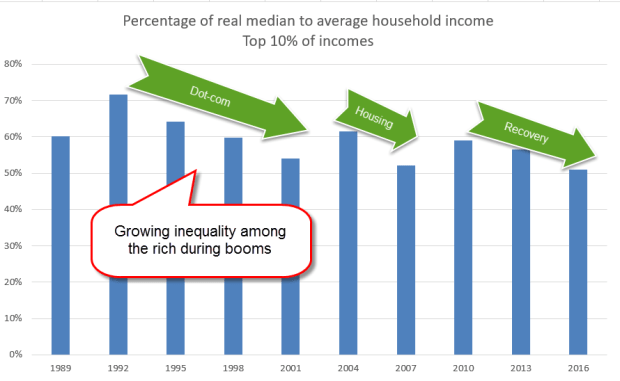
Much has been written about income inequality among households. During booms, there is a growing inequality even among those in the top 10% of incomes. The median in any data set is the halfway point in the numbers, and is usually less than the average of the numbers. If the numbers are evenly distributed the median is closer to the average and the percentage of median to average is high.  When there are a lot of outliers that raise the average far above the median, as in home prices, the percentage is lower.  During boom times there is growing inequality, even among the top 10%  of incomes. (Data from survey)

RealMedMeanIncomeRich

The growth of inequality of income obeys a power law distribution. Think of a 1’x1’ square. The area is 1. Now double the sides to 2’x2’. The area quadruples to 4. Triple the sides to 3’x3’ and the area increases by a factor of 9. Let’s imagine that the area inside of a square is money. How fair is it that the 2’ square has four times the money that the 1’ square has? Politicians may pass tax and social insurance laws to take some of that money from the 2’ square and give it to the 1’ square.  The redistribution of income and wealth can’t change the fundamental characteristics of a power law distribution. Despite the political rhetoric, solutions are bound to be temporary.

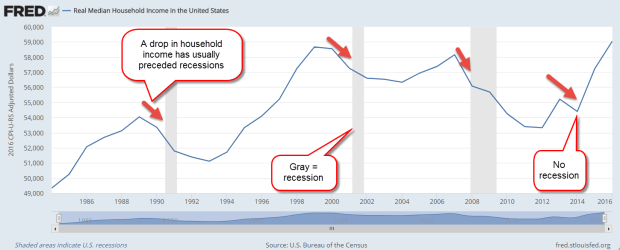
The income figures most cited are for households but this data has only been collected since the mid- 1980s. A fall in real median income usually precedes a recession except for the latest fall in 2014 when oil prices began to slide.

RealMedHHInc

Let’s turn to the data for family household income that has been collected since the mid-1950s. What is the difference between a household and a family? By the Census Bureau definition, a family household consists of at least one person who is related to the householder by blood, marriage or adoption. A fall in family income has preceded every recession except a mild one in the 1960s. Family incomes rose very slightly just before that recession, due in part to a new optimism about the presidency of JFK and the promise of tax cuts.

RealMedinc

Because this family income data is released annually at mid-year, this indicator is usually coincident with the start of a recession. However, it has proven quite reliable in marking the start of recessions.

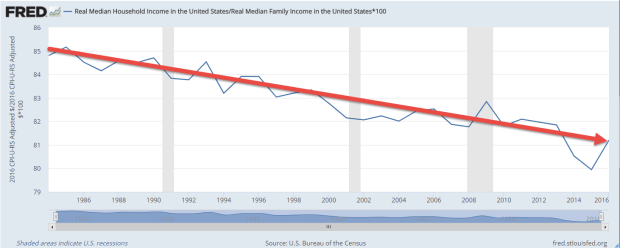
Non-family households are not related. This includes roommates or a childless couple living together but not married. Non-family households are generally younger and their income is less than the income of family households. Over the past three decades, the ratio of the incomes of all households to family households has declined.

RealMedHHIncVsFamilyInc

Although younger people are experiencing slower growth in incomes, they will face increasing pressure to meet the demands of older generations expecting social insurance benefits like Social Security and Medicare. As the oldest Americans begin living in nursing homes in increasing numbers, they are expected to put an ever-growing burden on the Medicaid system (CMS report).  It is the Medicaid system, not Medicare, which covers nursing home costs for seniors after they have depleted their resources. Although the number of nursing homes and certified nursing home beds have declined slightly in the past decade (CMS Report page 21), Medicaid spending still increased a whopping 10% in 2015 as enrollment expanded under Obamacare.

Colorado Governor John Hickenlooper has said that many states are expecting an increase in Medicaid spending on nursing home care as the first of the large Boomer generation turns 75 at the beginning of the next decade. CMS expects total health spending to increase 5.6% per year for the next decade. The last time we had nominal GDP growth that high was in 2006, at the peak of the housing boom.

The demands of both low income families and seniors on the Medicaid system will strain both federal and state budgets.  The federal government can borrow money at will; states are constitutionally prevented from doing so.

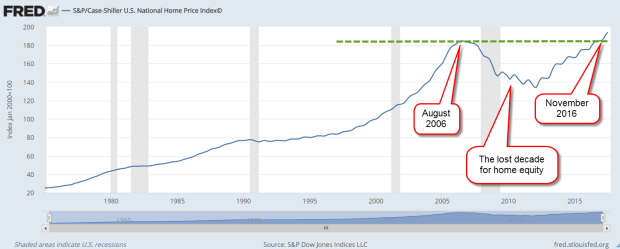
What will drive the high growth needed to sustain the promises of the future?  New business starts are at an all-time low (CNN money). How did we get here? The financial crisis caused the failure of many small businesses, many of which are funded with a home equity loan by an entrepreneur.  Home equity loans are down 33% from their peak in early 2009. At the end of last year, the Case-Shiller home price index finally regained the value it had in 2006. In the past decade there has been no home equity growth to tap into.

CaseShillerHPI201708

Imagine a couple in their late 30s or early 40s who bought a home 10 to 15 years ago. They may have only recently recovered the value of their home when they bought it. One or both may long to start a new venture but how likely are they to take a chance? In some of the bigger metro areas where home prices grew much stronger during the boom, prices are still below their peak ten years ago.

CaseShiller20City201708

The market has priced in a tax cut package that will lower corporate taxes. Investors are expecting a third or more of those extra profits in dividends. Investors are expecting a compromise that will enable companies like Apple to “repatriate” their foreign profits to the U.S. and for that money to be used to buy back stock or pay down debt, both of which are positive for stocks. The IMF projects 3.6% global GDP growth in 2018. There’s good cause for optimism.

Investors have not priced in the long term effects of this year’s hurricanes, the volatility of commodities, the future risk of conflict with North Korea, the risk that the debt bubble in China, particularly in real estate, could escape the careful management by the Chinese government. Add in the several fault lines in household finances that the Federal Reserve survey reveals and there is good cause to season our optimism with caution.

Individual investors surveyed by AAII are cautiously optimistic, a healthy sign, but the sentiment of actual trading by both individuals and professionals shows extreme optimism, a negative sign.  The VIX – a measure of volatility – just hit a 24-year low this past week, lower than the low readings of early 2007.  Sure, there was some froth in the housing market, investors reasoned at that time, but nothing that was really a problem.

Then, oopsy-boopsy, and stocks began a two year slide. So, don’t run with joy, Roy. Don’t go for bust, Gus. Pocket your glee, Lee. Stick with your plan, Stan. There are at least “50 Ways To Leave Your Money,”  and one of them is investing as though the future is predictable.


The Gravy Train

October 1, 2017

In the newly published “The High Cost of Good Intentions” author John Cogan relates a 230-year history of Federal entitlements, beginning with veterans’ pensions after the Revolutionary War. For 150 years the expansion of veterans’ benefits was prompted by budget surpluses brought on by high import tariffs. Each was targeted to a small number of soldiers who had died or become wounded during a war. Each program expanded into giant giveaways to any soldier or state militiaman and their wives.

Republicans expanded Civil War pensions to secure control of federal and state legislatures at the turn of the 20th century. Twenty years later, FDR and the Democratic Party used the same strategy of benefits to wrest control from Republicans.  First, the old system of service for benefits had to be curtailed. Like previous pension programs, benefits for WW1 veterans had been extended to those with non-service disabilities. Immediately after assuming office in 1933, FDR persuaded Congress to give him emergency authorization to alleviate the financial crisis. FDR eliminated almost a half-million veterans with non-service disabilities from the pension rolls and reduced pensions across the board. For the rest of the decade Congress tried to reinstate veteran’s benefits over the Presidential veto.

In 1934, the administration launched the New Deal, a series of programs to alleviate Depression-era hunger and unemployment. For 150 years, military service had been the prerequisite for federal benefits. Under FDR need, not service, became the primary requirement. An act of compassion quickly became a political tool that secured Democratic control at both the federal and state levels. Under the newly introduced Social Security program, a small amount of tax paid during the working years now entitled an older voter to federal pension benefits. No military service required.

For eighty years, benefit programs have become a political football. Two-thirds of the ten legislative increases to the Social Security program have occurred in election years. Today the total cost of entitlements is 60% of the $4.2 trillion in Federal spending.

If asked to list the federal entitlement programs, how many could we name? In addition to veteran’s benefits for service to the country, there are:
Income replacement programs like Social Security retirement and disability;
Income supplemental programs for poor families, such as the earned income tax credit (EITC), unemployment insurance, SSI and TANF;
Health insurance programs like Medicare and Medicaid, and the ACA’s health insurance subsidies;
Food assistance and price support programs like food stamps (SNAP) and child nutrition (WIC);
Business and individual loan guarantees and subsidized insurance programs including Sallie Mae education loans, FHA mortgage programs, and flood insurance subsidies.
This list does not include the many tax subsidies handed out by Congress.

I found that I could open this book at random and be both informed and entertained. Mr. Cogan combines an engaging narrative style and extensive research to construct an epic story of human need and greed, and the politics of pork.

I’ll turn to another book, “The Framer’s Coup” by Michael J. Klarman for some related backstory. At the Constitutional Convention in 1787, anti-Federalists objected to the “general welfare” clause of the proposed Constitution. What was to stop the Federal government from becoming a charity funded by taxes, they asked?

Nonsense, Constitutional delegates James Madison and Edmund Randolph countered, pointing to the enumerated powers in the Constitution as a restraint on the Federal government. Just as the anti-Federalists feared, the Court has long adopted a liberal interpretation of the Federal government’s enumerated powers. In the 1819 case of McCullough v. Maryland, Chief Justice Marshall set a precedent that the Congress could enact legislation that was “convenient or useful” to the exercise of its enumerated powers.  After that decision, then ex-President Madison admitted that if the Constitution had clearly stated the signers’ intention to firmly restrict the power of the Federal government, the Constitution would not have been ratified.

Turn the dial forward to the present. In the expansion of the welfare state during the 20th and 21st centuries, the Supreme Court has never found that the Federal government has exceeded its enumerated Constitutional powers. The most recent example was the Court’s finding that, under the enumerated power of taxation, the federal government could force people to buy health insurance under the ACA program.

The liberal interpretation of those two clauses – “convenient or useful” and “general welfare” – has unleashed the Federal government, whose agencies have become an omnipresent force in every American’s life. Each month, politicians in Washington take tax money from one set of voters and give benefits to another cohort of voters. Everyone  who receives benefits convinces themselves that they have paid into the system in some way. When it comes to tax money, it has always been better to receive than to give.

As the benefits to the receivers slowly exceed the taxes from the givers, there will be a crisis, and then some urgent half-baked legislative fix will be passed. I wish there was a better way.  Oh wait, I forgot.  There is a better way.  Paul Ryan, Speaker of the House, introduced the plan last year. Now that Republicans control the Presidency, Senate and House, they will fix the problem and avert a looming crisis of entitlements.  Silly me.  I can focus on the baseball finals now and stop worrying.

It’s Only Money

September 24, 2017

Republicans in Congress hope that they can enact comprehensive tax reform that will lower taxes for individuals and corporations. The Congressional Budget Office estimates  that, under current law and before any tax reform, the current $20 trillion deficit will grow to $30 trillion by 2026. They recommend a combination of decreased spending and increased revenue that would amount to $620 billion (in current dollars) annually, about 15% of current Federal spending of $4.2 trillion. CBO’s goal is to achieve a level of public debt to GDP that is about 40%, the 50-year average.

Lawmakers struggle to cut even 5% of spending but let’s assume that they could accomplish that and reduce spending by $210 billion. That might be the easier task. The Federal government is currently collecting 18.5% of GDP in taxes, a few tenths more than the 18.2% collected during the Reagan years. The CBO says that the dollars collected is not adequate to meet the Federal government’s current level of spending and obligations and they project that annual deficits will increase over the next decade. The 70-year average of federal revenues is 17.5% of GDP.

FedRevPctGDP

Raising an additional $410 billion, or 10% extra in revenue, will require raising taxes or increasing GDP. Republican lawmakers and some economists hold fast to a theory that reducing tax rates will increase economic growth. To raise an additional $410 billion for a total of $4 trillion dollars, and collect the 50-year average of 17.9% of GDP in tax revenue, GDP next year would need to be almost $23 trillion, a whopping 20% increase from the 2016 level of $19 trillion. No amount of tax decrease will spur that much growth. A Republican Congress will not pass a tax increase.

In a recent Senate budget committee hearing, I was surprised to learn that half of the cost of corporate taxes is borne by the workers, as estimated by the Tax Foundation. The OECD finds that corporate income taxes are most injurious to people’s incomes and is why most developed countries have lower corporate tax rates than the U.S. These countries augment their revenues with a consumption tax, most often a VAT, or value added tax. Another surprise: consumption taxes are less of a burden to a worker than higher corporate taxes.

The founding of this country was instigated by a protest over a tea tax. In the Framer’s Coup, Michael Klarman relates the bitter debates over slavery and taxes at the 1787 Constitutional Convention. 230 years later, the debate over slavery may have ended but the debates over taxes are just as ferocious.

Since last November, the stock market has priced in the probable passage of tax reform by the end of this year or early next year. Republican lawmakers have been unable to repeal Obamacare and I think they will have an equal amount of difficulty passing tax reform.

CBO budget projections restrain the freedom of lawmakers to enact their favorite theories. Lawmakers are highly motivated to answer the whoops and hollers of their voters, many of whom may not be interested in the achingly dull but necessary procedures of budget craft. The parliaments of European governments can enact sweeping legislative changes that are difficult under our federalist system. The U.S. chose a different path of checks and balances embedded in a Constitution hammered out by compromise and a suspicion of human beings given legislative power. Time and time again we are reminded that those suspicions were well founded. Voters and lawmakers may become frustrated with the procedural obstacles of crafting legislation but the U.S. Constitution is the longest living Constitution because of those obstacles.

History lesson done. Stock investing lesson: don’t count your tax reform before it hatches.

Bull Runs

September 17, 2017

Lloyd Blankfein, the CEO of Goldman Sachs, commented recently (CNBC) that the length of this bull market has worried the traders at Goldman. Being a curious sort, I wondered how this bull market compared to previous ones. Wanting a big picture, I looked at the quarterly data for the SP500 index for the past sixty years. A lengthening sequence of quarterly closes above the three-year average is a reliable indicator of a bull market.

In the 1980s, the SP500 had a run of 19 consecutive quarters above its three-year average. That streak ended in the 3rd quarter of 1990, at the start of a mild recession that lasted until March 1991. The animal spirits of the stock market could not be contained for that long. After one quarter down, the market began another streak in the 4th quarter of 1990, a monster bull run of 40 consecutive quarters above the average until the first quarter of 2001.

BullRun1990s

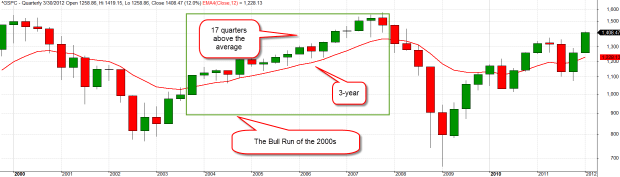
The end of the dot-com boom, the start of a mild recession, then 9-11, the Enron and accounting scandals – all of it led to a 50% drop in the index. Almost three years later, the market finally closed above its three-year average. That began a 17-quarter bull run that ended March 2008.

BullRun2000s

People were getting woke to the reality that housing prices can go down. The neighbor living in the house behind my folks in NYC said to me, “I don’t know what’s going on. Housing prices are not supposed to go down.” As though housing prices obeyed a fundamental physical law like gravity. The bailout of Bear Stearns that first quarter of 2008 was just the beginning of a developing financial crisis that would cripple the global economy. In 2010 and 2011, market prices clawed their way above the 3-year average only to fall back.

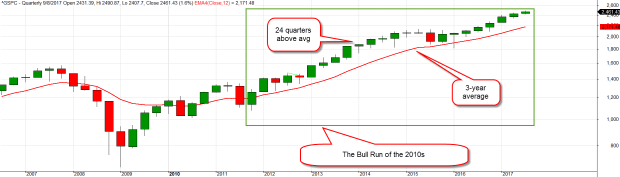
Finally, in the last quarter of 2011, after the fitful resolution of the budget crisis, the SP500 broke again above its 3-year average. Since then the market has notched 24 consecutive quarters above that average. This latest bull run has beat every previous SP500 streak except for the 1990s run up.

Bullrun2010s

This is what is worrying Blankfein and the traders at Goldman. Long bull runs in the past have ended horribly.  Like the bull run in the 1990s, there have been few negative, or corrective, quarters during this run.  Those are the quarters in red in the chart above. Some negative sentiment acts as a constraint on ever climbing asset prices.  For now, investors are convinced that inflation and interest rates will remain low, a prime environment for stocks.

Employment Trends

September 10, 2017

I’ll review a few notes from last week’s employment report and highlight some long-term trends. There’s good news and bad news.  Figuring out the future is tough because it hasn’t happened yet.  Heck, scholars still haven’t figured out what went on in the past.

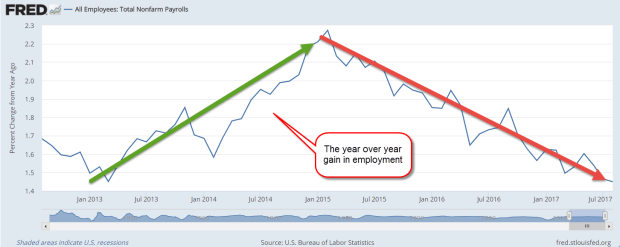
The unemployment rates are computed from a Household Survey and is a self-reporting statistic. The answers of survey respondents are not verified. The monthly job gains come from a separate survey of businesses and the data is more reliable. One of the recession indicators I use is the change in employment from the business survey. I regard a 1% year-over-year gain as a minimum threshold for a stable or growing economy. 1% is about the rate of population growth. If our economy cannot keep up with population growth, that is a pretty sure indicator of a coming recession. Here is a chart of the past five years. Growth is still above 1% but there is a definite downward trend.

Employ201608

Here’s a graph of the past two recessions showing that crucial decline below the 1% threshold.

Employ99-09

Due to higher manufacturing employment and higher population growth during the 1960s – 1980s, the recession threshold was closer to 2%. Here’s a graph of the 1970s to 1990s. The exception that broke the rule was the economic shock of the 1973 Arab-Israeli war. The oil embargo that followed straightjacketed the U.S. economy.

Employ1973-1993

The NAFTA agreement signed in the early 1990s began an erosion of the manufacturing base and employment in this country. Still, the decline was rather mild until China was admitted into the WTO in 2001. The streamlining of ocean shipping and land transport of goods by cargo container reduced costs and catalyzed a mass migration of manufacturers and supply chains to China and southeast Asia.

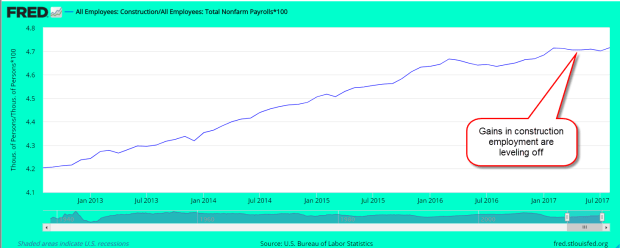
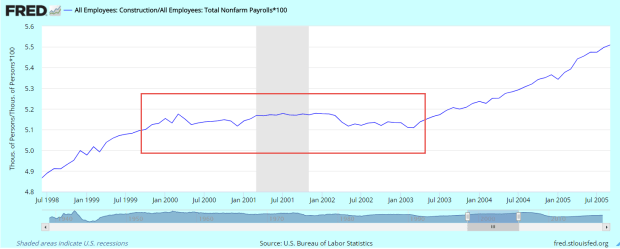
Gains in construction employment are waning. A sustained plateau followed by a decline precedes every recession.  Notice that the growth is not in the actual number of construction employees but in the percentage of construction employment to total employment.

ConstructEmploy

A plateau in construction employment began in April 2000 and persisted through one recession till the spring of 2003. In late 2002, there was talk of another recession. Fed chair Alan Greenspan continued to push rates down to 1% to ward off the boogie man of recession.

ConstructEmploy1998-2005

With unemployment as low as it is, wage growth should be stronger.  In the latter part of 2016 and earlier this year the hourly earnings of private employees sometimes pushed toward 3% annual growth. Since April, growth has stayed rock steady at a mild 2.5%.  It’s like some joker is laughing at the dominant economic models.

Speaking of predictive models, the Fed has discontinued the Labor Market Conditions Index (LMCI), a broad composite of 19 employment indicators. As a general picture of the employment market, it was satisfactory. As a predictive tool of developing trends, the Fed thought it was too sensitive. For those readers who would like a deeper dive, Doug Short of Advisor Perspectives examines the Feds remarks on this index.

/////////////////////

Lloyd Blankfein, the CEO of Goldman Sachs, commented recently (CNBC) that the length of this bull market has worried the traders at Goldman.   Next week, I’ll compare this bull run with those of the past.

Vulnerable

September 3, 2017

Hurricane Harvey invaded the lives, homes and businesses of so many people in Houston and the surrounding area of southeast Texas. People around the world watched the plight of so many who were caught in the rising waters. I was cheered by the dedication of first responders, by those who came from near and far to help with their boats, with food and clothing. I have never been in a flood. Some of those interviewed had been in several. Why do they stay there, I wondered? The answer is some or all of these: their family, their church, their job, their school, their culture.

Watching so many vulnerable people reminded me of my own. If given a few minutes to leave my house, what would I put in a garbage bag? In the urgency and stress of the moment so many people in Houston forgot their medications.  My list: Pets, papers, clothes, medications. Food? Will the shelter have food? Pet food, as well? Where are we going? Oops, what about a phone charger? And the laptop. What about the list with all the passwords? That too. What about the photos in the closet? I was going to get those scanned in and uploaded. No time now. Take a few of the smaller framed photos on the shelf in the living room. Out of time. Gotta go. All the questions that must have been bouncing around inside the heads of those forced to evacuate as the brown water took possession of their house.

If I don’t call it Climate Change, I could call it Flood Frequency, or Flood Freak for short. Here is a chart showing the increased frequency of flooding during the past century. This was from an article in the WSJ (paywall).

FloodFrequency
This week’s theme – vulnerability. The signs of it and what we can do to lessen it. Debt is a vulnerability. For the past three years, households have been increasing their debt load in mortgages, auto and student loans. Here’s a breakdown of household debt from the NY Fed. (As a side note, this report gives a breakdown of the different types of debt by credit score. For example, the median credit score for an auto loan is about 700).

DebtBalance2016.png
Mortgage debt is more than 2/3rds of total debt. Despite the rise in home prices, more than 5 million homes, or 7%, are still badly “under water.” (Consumer Affairs)

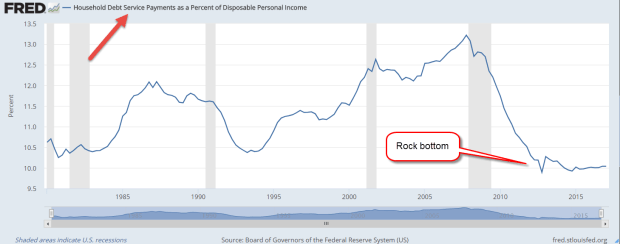
Credit card debt has stayed stable for the past thirteen years. Households are only using 10% of their after-tax income to service their debt.

DebtService2016

Despite low interest rates, households are continuing to deleverage, to decrease their vulnerability. The ratio of household debt – the total of that debt, not the payments – to income climbed above 2.5 in late 2007. It has fallen below 2.2 but is still high. We are still up to our eyeballs in debt.

HouseholdDebtIncomeRatio

Debt reduction will curb economic growth for the near future. According to several cabinet members, Trump is focused on GDP growth in discussions about trade policy, defense policy, infrastructure spending, and the regulatory environment. How does this or that policy get us to 3% growth? he asks.

2/3rds of the nation’s economy is based on the public willingness to spend money. Jobs helps. Higher wage growth helps. Low interest rates help. But without the willingness to take on more debt relative to income, policymakers may feel like they are trying to goad a stubborn mule to go faster. Tough to do.

//////////////////////////////////

Unemployment

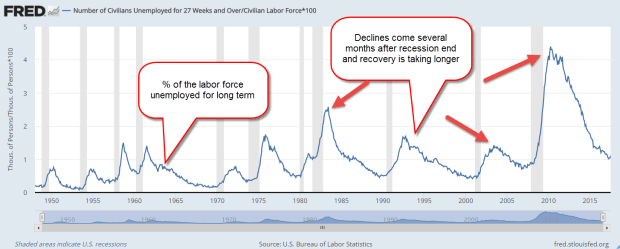
Continuing the theme of vulnerability.  As a percentage of the unemployed, the number of long-term unemployed remains stubbornly high at close to 25%.  I call them the 27ers because 27 weeks of unemployment is the cutoff that the BLS uses to determine whether someone is categorized as long term unemployed. 27 weeks or six months is a long time to be actively looking for work and not finding a job.  Eight years after the end of the recession, today’s percentage of 27ers is at the same level as the worst of most past recessions.

LTUnemploy

During any recession the number of long term unemployed climbs higher. When these past few recessions have ended, the number of 27ers doesn’t start to decline.  Instead, they continue to increase and reach a peak several months after the recession is officially over. In the last three recessions, the peaks came later than previous recessions.

UnemployLTPctCLF
This more vulnerable cohort in the labor force struggles to recover after a recession.  Manufacturing is the more volatile element in the business cycle.  As manufacturing has declined, recessions are less frequent. However, manufacturing used to put a lot of people back to work at the end of recessions.  In a recovery, the service sectors are not as quick to add jobs.

The structural shift in the labor force will continue to leave more workers and families vulnerable and needing help just as many older workers are claiming retirement benefits. More than half of voters, both Republican and Democrat, have received benefits from at least one of the six entitlement programs (Pew Research). Elected officials offer promises of future benefits in exchange for taxes, and votes, today. When circumstances force a clash of priorities and promises, Congress seems incapable of resolving the conflict. President Trump’s approval ratings are in the low thirties, but his popularity far exceeds the public’s dismal ratings of Congress.

In a crisis, Americans come together to help each other but why do we wait till there is a crisis? Have we always been a nation of drama queens?  Maybe that’s the American charm.