Growing Signs

February 8, 2015

Employment

Employment gains in January were at the midpoint of expectations but revisions to the gains of November and December were significant, adding about 70,000 jobs in each month.  After a decline in December, average hourly earnings rose to $24.75, for a year-over-year gain of 2.2% and a good 1% above inflation.

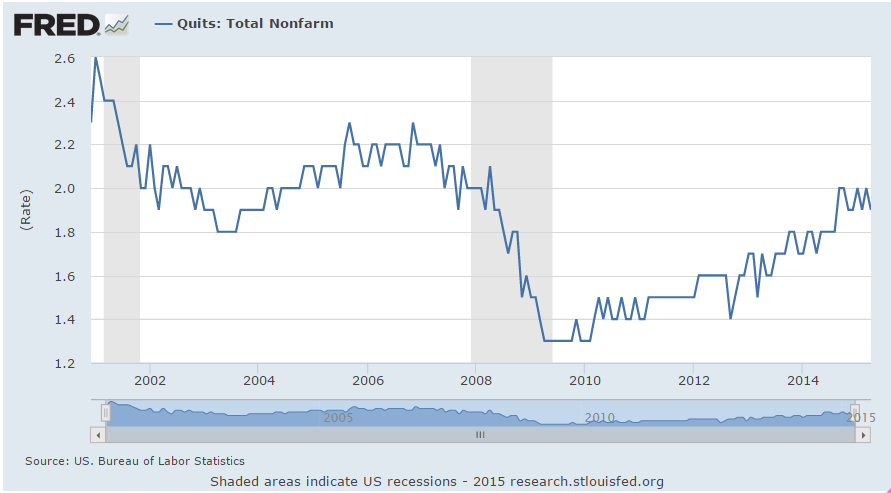
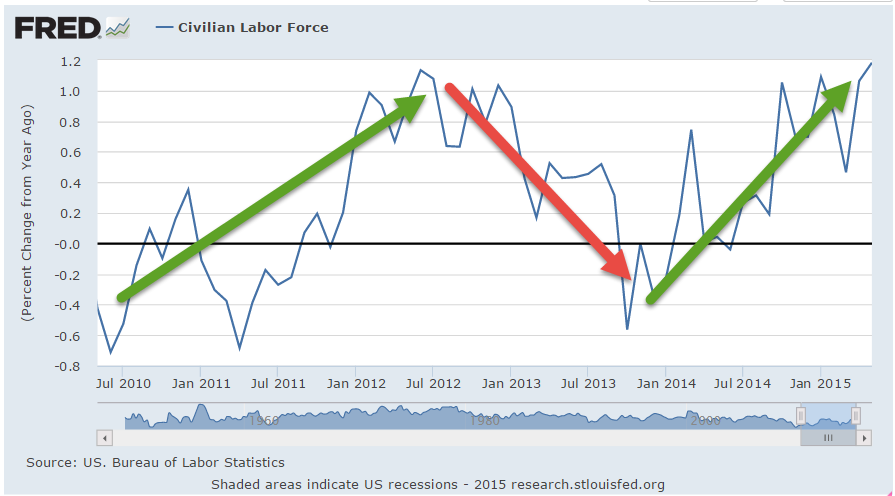
In a sign that people are becoming more optimistic about job prospects, the Participation Rate increased 2/10ths of a percent in January.  After 5 years of decline, this rate may have found a bottom over the past year.

The health or frailty of the core work force aged 25 – 54 years is  a snapshot of the underlying strength of the labor market.  This age band constitutes our primary working years.  In the first half of this thirty year period we build job skills, work and social connections, establish credit, and accumulate relationships and stuff.  Year-over-year growth in the 1 to 2% zone is the preferred “Goldilocks” growth rate.

As the graph below shows, the growth rate has been above 1% for most of the past year.

Monthly gains in construction employment have overtaken professional business services and the health care industry.

The construction industry accounts for less than 5% of employment but each employee accounts for a total of $160,000 in spending so changes affect other industries.  As you can see in the graph below, real or inflation-adjusted construction spending per employee was relatively stable during the 1990s.  As the housing market boomed, spending per employee rose dramatically in the 3-1/2 years from late 2002 to early 2006.  In the worst throes of the recession when the industry shed almost a quarter of its employees, per employee spending stabilized at the same level as the 1990s.

Stimulus spending and Build America projects helped cushion the decline in construction spending but as those programs concluded, spending fell to a multi-decade low in the spring of 2011.  Despite historically low interest rates and increasing state and municipal tax revenues, both residential and commercial construction are below the benchmark set in the 1990s.  Despite strong gains in the past two years, the industry still has room to run.

As the economy improves, those working part time because they can not get full time work has decreased significantly from the nosebleed heights of five years ago.

That total includes those whose hours have been cut back because of slack business conditions.  A subset of that total are the number of workers who are working part time because they can not find a full time job.  This segment of workers has seen little change during this recovery.

*****************************

Purchasing Manager’s Index

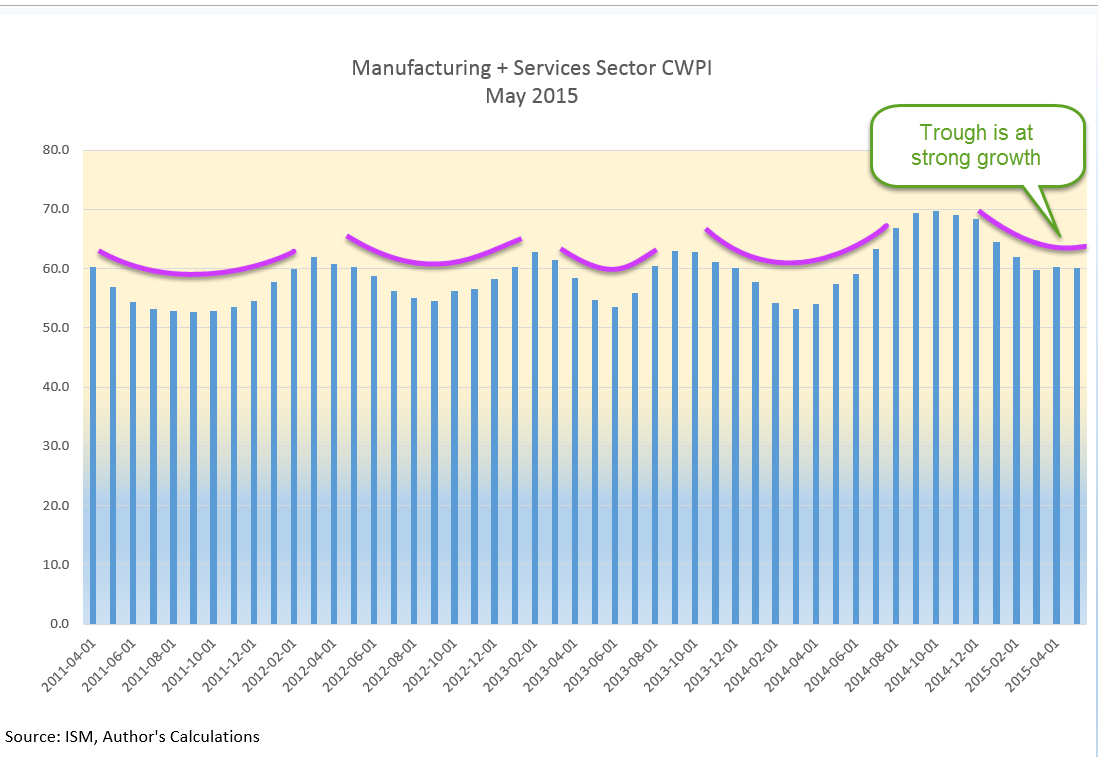
Each month I update a composite index of the ISM Purchasing Manager’s indexes (PMI) first introduced by economist Rolando Pelaez in 2003.  This composite, the Constant Weighted Purchasing Index, or CWPI, reached record highs in October 2014.  It is no surprise that, this month, the BLS revised November’s employment gains upwards by 70,000 to over 420,000.  As expected, the composite has declined but remains robust.

The wave like pattern of present and anticipated industrial activity has quickened since early 2013, the troughs and crests coming closer together.  If this pattern continues, we should expect gradual declines over the next two months before rising up again.  A combination of employment and new orders in the service sectors continues to show healthy growth, although it has also declined from the strong growth of the past few months.

GDP, Unemployment, Wage Growth

Feb. 1st, 2015

GDP

The first estimate of 4th quarter GDP growth was 2.6%.  This figure is truly a guesstimate and is sometimes heavily revised in the following months. Last October, the first estimate of third quarter GDP growth was 3.5%.  As data continued to roll in, that estimate was revised upwards by a whopping 42% to 5.0%.

The year over year growth in inflation-adjusted, or real GDP was 2.5%, more or less following a trend that is four years old.

On a per capita basis, GDP growth is near 2%, the average rate of growth since World War 2.

Let’s get in the wayback machine and look at per capita GDP growth over the past four decades.  Reagan and Clinton groupies can leave the room now.  The adults are going to talk.  The 1970s and first half of the 1980s were a period of high inflation and erratic growth – up 5%, then down 3%.

Growth above 3% for any length of time leads to distortions in investment and the labor market which generates a subsequent downward correction lasting several years.  Above average growth in the late 1980s was followed by a three year period of below average growth in the early 1990s.  The strong growth of the late 1990s was fueled by a boom in dot-com investment and telecom coupled with ever rising house prices.  The above 3% growth of those years sparked an inevitable correction lasting three years, bringing us back to the 2% average.

The housing boom of the 2000s generated above average growth followed yet again by a three year correcting downturn. For those families who have struggled to recover from the recession, average growth may be too slow and too small.  On the other hand, average growth is less likely to lead to a rebalancing recession.

*************************

Unemployment

Much ado this week when the Labor Dept announced that new claims for unemployment dropped more than 40,000 to 265,000.  The week after the Martin Luther holiday is typically volatile each year with little consensus on the reasons.  The somewhat erratic weekly numbers are smoothed by using the four week average of new claims.  That average has been just below 300,000 since September.

Low numbers for the newly unemployed is good, right?!  As with GDP, too much of a good thing for a period of time may be a precursor to an offsetting period of not so good.  Such is the law of averages.  As a percent of the labor force, new claims are at the same low level as in mid-2000 and late 2006.

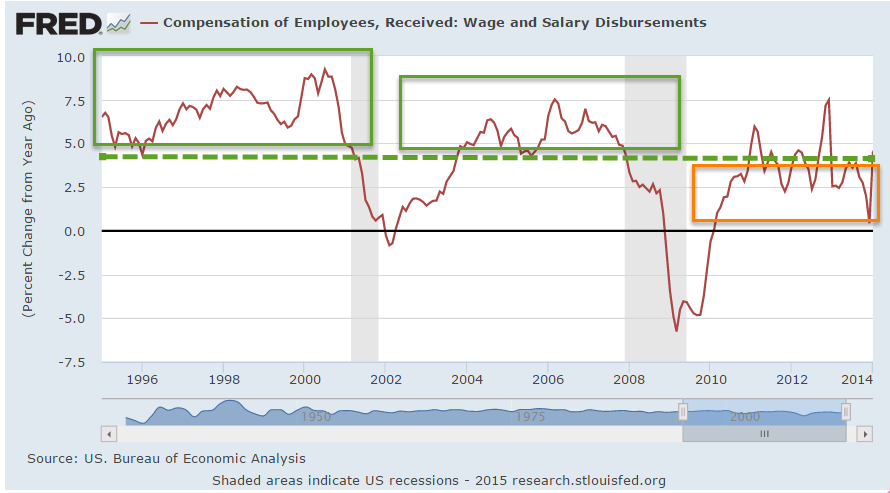
As the demand for labor increases, employers make compromising decisions out of necessity.  They hold onto low productivity workers. Workers who are let go can more readily find new jobs.  The number of new claims remains low.  Re-entrants into the job market help to reduce the pressure for wage increases but eventually wages begin to move upward.  Employers may cut margins to pay workers more than their productivity is worth.  Real wage growth climbs as the percentage of new unemployment claims remains low.

In the graph above I have highlighted two previous periods where new unemployment claims were low as real wage growth climbed.  The graph below illustrates the point a bit clearer.  It is based on the Employment Cost Index, a relatively new series about ten years old, that tracks the total employment cost, including benefits and required employment taxes and insurance.

Historical data suggests that a growing divergence between these two factors may play some part in generating an imbalanced economic environment – one that, unfortunately, soon rights itself.

*************************

Market Timing

The link to Doug Short’s blog is on the right side of this page but in case you might miss it, here is Doug’s monthly update of moving averages and the simple allocation model of the Ivy Portfolio.    The 10 month simple moving average crossover is similar to the 50/200 day crossover system I have mentioned numerous times: i.e. the Golden Cross and Death Cross.  Either system will help a person avoid the worst of a protracted downturn as we saw in the early 2000s and 2008 – 2011, and capture the majority of a long term upswing.

For those of you who have not read it, the Ivy Portfolio is a keep-it-simple allocation and timing model of domestic and foreign stocks, real estate, commodities and bonds using low cost ETFs.

Then and Now

January 25, 2015

Valuation

Blogger Urban Carmel has written a thorough article on current market valuation, focusing on Tobin’s Q as a metric.  This is the market price of equities divided by the replacement cost of the companies themselves.  During the past 65 years, the median ratio is .7, meaning that the market price of all equities is about 70% of the replacement cost.  At the end of December, the Tobin’s Q ratio was more than 1.1.

Are stocks overvalued?  Valuing the replacement cost of a company might have been more accurate when the assets were primarily land, factories and other durable equipment.  Today’s valuations consist of networks, processes, branding, and other less easily measured assets.  The valuation discussion is not new.  In 1996, before the U.S. shed much of its manufacturing capacity, economists and heads of investing firms argued about valuation, including Tobin’s Q.  You can punch the way back button here and read a NY Times article that could have been written today if a few facts were changed.

Currently, households have 20% of their financial assets in stocks, the same percentage as in 1996.  In December 1996, then Federal Reserve chairman made a comment about “irrational exuberance”  in market valuations.  Prices would continue to rise, then soar, before falling from their peaks in mid-2000.  At that peak, households held 30% of their financial assets in stocks.  At an earlier peak, 1968, households had the same high percentage of their assets in stocks.

On an inflation adjusted basis, the SP500 has only recently closed above the all time high set in 2000 (Chart here).  The Wilshire 5000 is a market capitalization index like the SP500 but is broader, including 3700 publicly traded companies in its composite. On an inflation adjusted basis this wider index is 40% above the peaks of 2000 and 2007.

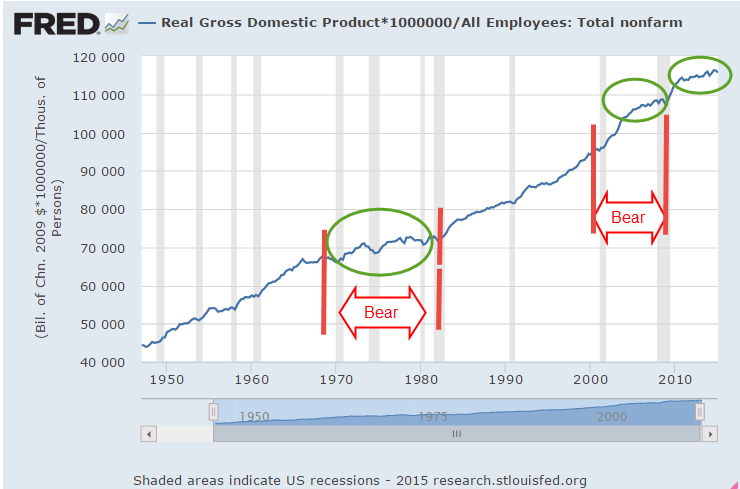
Long term periods of optimistic market sentiment are called secular bull markets. Negative periods are called secular bear markets. (See this Fidelity newsletter on the characteristics of secular bull and bear markets).   These long-term periods are easier to identify in hindsight.  Some say that we are nearing the end of a long-term bear market, and that there willl be a big market drop to close out this bearish period.  There have been so few long term market moves in 150 years of market data, that it is possible to tease out any pattern one wants to find.  The aggregate of investor behavior is not a symphony, a piece of music with defined structure and passages.

******************************

REIT

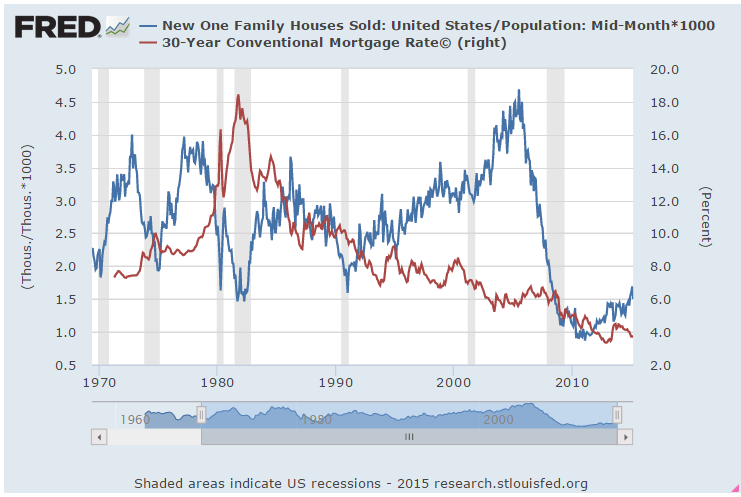
As Treasury yields decline, mortgage rates continue to fall.  The Mortgage Bankers Association reported  that their refinance application index had increased by 50% from the previous week.  The refinancing process involves the payoff of the previous higher interest mortgage.  Mortgage REITs make their money on the spread, or the difference, between the interest rate they pay for money and the interest on loaning that money on mortgages.  When a lot of homeowners prepay their higher interest mortgages, that lowers the profits of mortgage REITs like American Capital Agency (AGNC) and Annaly Capital Management (NLY).  Both of these companies have dividend yields above 10% and are trading below estimated book value.

*****************************

Housing

Back in ye olden days, around 1950, the world was a bit different.  The Bureau of Labor Statistics published a snapshot of incomes, housing, and other census data, including the data tidbit that people consumed fewer calories in 1950 than today, 3260 then vs. over 3700 today.

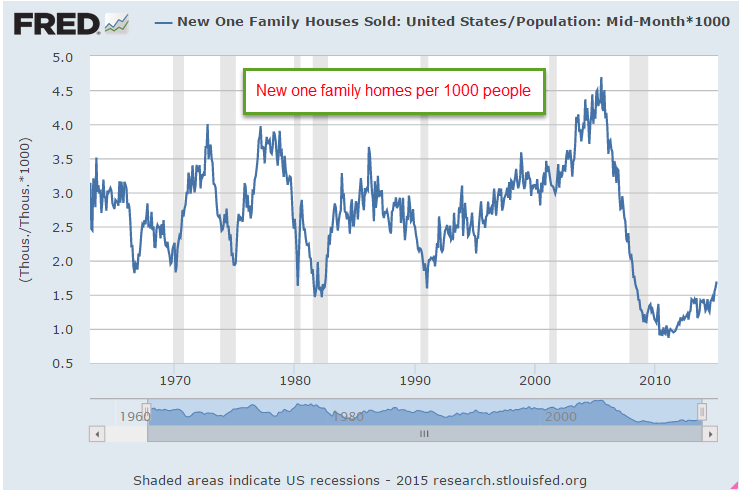
Housing and utilities averaged 27% of income in 1950 vs. 40% today.  Food costs were 33% then, 15% today.  The median house price of $9500 was about 3 times the median household income (MHI) of $3200.  For most of the 1990s, the prices of existing homes were slightly higher, about 3.4 times MHI.

The prices of existing homes rose 6% in 2014 – healthy but not bubbly.  However, the ratio of median price to median income is now at 3.8.  Historically low interest rates have enabled buyers to leverage their income to get more house for their bucks, but the lack of income growth will continue to rein in the housing market.

The ratio of median new home prices to MHI has now surpassed the peak of the housing bubble.

*******************************

Retirement Income

Wade Pfau is a CFA who has written many a paper on retirement strategies and occasionally blogs about retirement income.  Here is an excellent paper on the change in psychology, risk assessment and strategies of people before and after retirement.  Wade and his co-author summarize the critical issues, the two dominant withdrawal approaches, the development of the safe withdrawal rate, and the caveats of any long term planning.  The authors review the strategies of several authors, discuss variable spending rules, income buckets and income layering,  annuities, and bond ladders.  You’ll want to curl up in an armchair for this one.

Dance Partners

January 18, 2015

When investors are grumpy, good news is not good enough or it is too good.  Confidence among small businesses climbed to levels not seen since late 2006 and the positive sentiment was broadly based, including new hiring and plans for expansion.

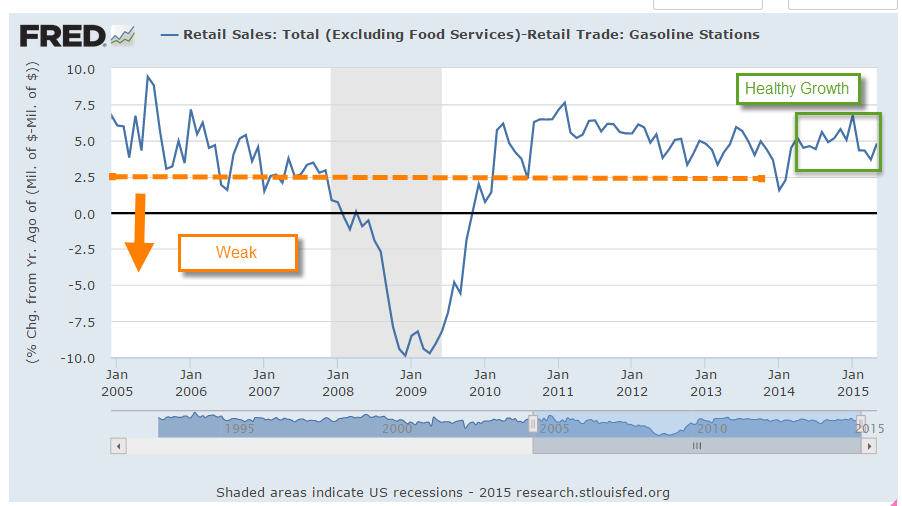
On the other hand…December’s 9/10% decline in retail sales was a surprise after a strong November.  However, a closer look at the retail figures shows some real positives.  The year-over-year gain was 2.6%, above the 1.7% core inflation rate, indicative of modestly  growing demand.

Excluding retail gas sales, retail sales gained 4.8% over last year.

Now, let’s put gas sales in some historical perspective.  In January 2007, the price of a gallon of gasoline was $2.10, about the same as it is now.  On average, we are driving more fuel efficient vehicles than in 2007, yet total retail gas sales are 25% higher now.

Every six weeks, the Federal Reserve releases their Beige Book survey of economic conditions around the country.  They also reported moderate growth in employment and sales.  They noted that flat wage growth and low inflation reduces any urgency in raising rates.  Friday’s release of the CPI confirmed the low inflation rate.  Including gas and food, the yearly increase was only .7%.  Core inflation, which excludes gas and food prices, rose 1.7%.  Consumer sentiment is nearing the levels of the early to mid-1980s, the beginning of a period of strong growth.

For now, stocks and oil prices are dance partners.  In a week of negative sentiment, traders were watching the 1975 level on the SP500.  This was mid-December’s bottom, a short-term key level of support.  After Thursday’s close near 1990, stocks rallied on the strong consumer sentiment and a report from the International Energy Agency that lower prices are causing some oil production cuts. Fourth quarter earnings season has just begun but if volatility in oil prices remains strong, this may drive market sentiment at least as much as earnings reports.

************************

Job Openings (JOLTS)

November’s job openings showed a slight increase, getting ever closer to the 5 million mark and nearing an all time high set in the beginning of 2001 as the dot-com boom was ending.  This summer open positions surpassed the mark set in June 2007 at the end of the housing boom.

The  economy grows stronger on many fronts – labor, retail, housing and industrial production – and is near multi-year high marks without the help of a widespread boom in any one sector of the economy.  The surge in oil  shale production is confined to a few states.

*************************

Portfolio Allocation

As the market remains somewhat volatile, it’s time to revisit a familiar theme – allocation.  Let’s look at a selection of portfolios with moderate allocation. How much difference has there been between a portfolio with 60% stocks and 40% bonds (60/40), and one with 40% stocks, 60% bonds (40/60)?

Earlier in the year, I mentioned a site  that can backtest a pretend portfolio.  In the free version, the re-balancing rules are fairly simple but it does allow us to make some comparisons of long term trends.

All of the following tests include the years 2000 – 2014, a period which covers two downturns.  The first, from 2000 to 2003, was a protracted decline after the dot com bubble.  The second, from late 2007 to 2009, was severe.

The test includes an annual re-balancing to get to the target percentages, and assumes a modest investment of $100 each year into a $10,000+ portfolio.  Because of the two downturns, it’s no surprise that the portfolio weighted toward bonds did better than the portfolio weighted toward stocks.

The difference between the 60/40 and 40/60 was about 7/10% in annual return.  If we were to use intermediate term bonds as a proxy for the bond component of the portfolio, the difference would be even less.  In the middle range of allocation models, the differences in returns over a long period of time are probably smaller than what we worry about.

The importance of moderate allocation is illustrated by the following two examples.  Let’s consider the period from 1995 – 2014, which includes three market rises and two downturns.  Note the ratio: three up to two down.  If we compare a portfolio of all stocks to a balanced portfolio of 50% stocks and 50% long term bonds, we see that it is only in the past five years that the all stock portfolio finally meets the return of the balanced portfolio.

Long term bonds are especially sensitive to changes in interest rates so let’s look at a balanced portfolio of stocks and intermediate term bonds.

In this case, it is only in the past two years that the total return of the all stock portfolio has outperformed the balanced portfolio.  One of the those years included an unusual 30% gain in one year.  In short, it is hard to argue against a balanced portfolio over a long period of time.

Lastly, the example below shows a slight advantage to re-balancing a portfolio.  However, the additional .2% gain each year should not cause us to lose sleep if we forgot to do this for a few months.

****************************

Oil Prices

Oil suppliers are pumping down their inventories as global demand for oil weakens.  More product, less demand = lower prices. In a standard economic model, customers want more of a good at a lower price.  Suppliers are less willing to supply a good at a lower price.  Eventually, suppliers and customers reach an equilibrium at a certain price.

What happens in a price war does not follow this simplified textbook model.  Suppliers with deep reserves try to drive out other suppliers by flooding, or at least over supplying, the market, thus driving the price down.  More units are bought but at lower prices, so the value of gross sales may be lower even though the units sold is higher than before.  The profit on each unit sold, or marginal profit, gets lower and may get negative for a time till the more vulnerable suppliers leave the market.

The governments of Venezuela, Russia and Nigeria depend on oil revenues for much of their income.  Should oil prices stay below $50 for half a year or more, these countries will be pressed to curtail social benefit programs and infrastructure projects.  The interest rates on their bonds will increase as investors price in a greater risk of default.

Sudden changes produce fractures.  Fractures produce frictions. Frictions dissipate in a cascade of minor adjustments or suddenly in a violent upheaval.

Rollercoaster

January 11, 2015

Price movement continued to be volatile in this second week of the year.  Despite all the price gyration, the SP500 is down only 1% since the first of the year.  On Monday, light crude oil broke below the $50 price barrier, helping to usher in a rush to safety, namely U.S. government debt.  As the prices of long term Treasuries climb upwards, who is buying this Federal debt?  As the chart below shows, foreigners already hold the majority of Federal Debt.

As the dollar continues to strengthen, institutional investors around the world buy Federal Debt to enhance the return on their savings. Let’s say a European investor bought $132 of Treasury debt on September 1, 2014 for €100. Now that same investor cashed in that U.S. Treasury bill this past Friday.  What does the investor get back?  €111.46, without any accrued interest or fees included. In a little over 3 months, they have made almost 11-1/2% return, an annual rate of more than 40%.

On the other hand, the “carry trade” is getting squeezed.  The carry trade involves borrowing money in a country with a low interest rate, or borrowing low, and buying debt in another country with a higher interest rate, or loaning high.  This is a great deal – easy money – IF the currency of the country where an investor borrowed the money doesn’t start rising in value as the U.S. dollar has done recently. The problem is particularly acute in emerging countries which have higher interest rates to attract capital.

To keep the example simple, let’s use the euro again.  On September 1st, a European investor bought €100 of  French BTFs paying 5%.  Because interest rates are so low in the U.S., the  European investor was able to borrow the money in the U.S. for 1/2%, making 4.5% for doing nothing.  The investor borrowed $131.30, converted it to €100 and bought the BTFs.

This past Friday, the U.S. bank calls the investor’s loan so the investor cashes in her €100 BTF and gets only $118.42 at the current exchange rate.  They are short $12.88, an annualized loss of almost 36%.  What makes this simple scenario even more dangerous is that, in the real world, the investor has often leveraged their money, multiplying the losses.

The problem becomes particularly acute for companies headquartered in an emerging market (EM) country but which have a U.S. subsidiary.  The subsidiary borrows money at a low interest rate in the U.S., much lower than the prevailing rate in the EM country, then converts those dollars to the currency of the EM country to fund expansion.  If the EM currency loses value against the dollar, the company finds it increasing difficult to make payments on their loan because each time they convert their EM currency to U.S. dollars, the EM currency buys fewer dollars.  This is another kind of squeeze that may cause the bank to call the loan, or escalate the loan to a higher interest rate, creating even more financial pressure on the company.

This is the first time in fifteen years that the U.S. dollar has gained in strength against all major currencies.

***********************

Purchasing Manager’s Index 

As expected a few months ago, a composite of employment and new orders in the services sector continued to moderate in December.  In September, these two key factors of production were at the highest levels in 17 years, so some decline was anticipated toward the end of the year.

The CWPI, a composite of manufacturing and services sector activity in the country, continues to run strong, although it has also moderated from the higher peak set in October 2014.  The wave like pattern of economic activity is getting stronger over the past several years.  The peaks are coming closer together and now the strength of activity has quickened.

Despite these strong economic indicators, investors are worrying again (see October blog)  that the rest of the global economy is faltering. Why investors showed less concern about the global economy in November and December remains a puzzle. To longer term investors, the market seems to have the attention span – and frenetic activity – of a three year old.

************************

Employment

In December, employment rose 2.1% year over year, almost besting the high set in March 2006 for yearly growth.

There were several positives in this report.  Job gains for October and November were revised up 50,000 total.  The core work force, those aged 25 – 54, continued a steady rise. The number of people employed at part time jobs because they couldn’t find full time work fell again in December by 60,000 and is down 13% over the past year.  However, there are still 50% more involuntary part-timers than during the 2000s.

The number of long term unemployed people has fallen 28% in the past year but – that word “but” rears its ugly head again – are still high.

Investors tended to focus on the negatives in this month’s report.  The number of discouraged workers, those who are available for work but haven’t looked in the past month, was up 42,000.

As a percent of the labor force, the long term unemployed and discouraged are still at historically high levels – more than five years after the official end of the recession.

Hourly wages declined by .05 to $24.57 but the influx of seasonal and part time jobs at the holidays and year end may have had some impact.  Last month’s slight increase in hourly wages sparked hope that employees might be gaining some pricing power, indicating an underlying strong demand from employers.  This month’s data suggests that lower gasoline prices will have to substitute for wage growth in the near term.

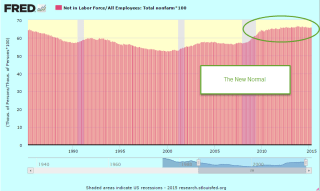
The Labor Force Participation rate edged down .2 and seems to be stuck in a range just under 63% for the past year.  If the labor market were really growing strongly, we would expect to see some upward movement as more people tried to enter or re-enter the job market.

************************

Social Security Calculator

Last year the Wall St. Journal reviewed several social security claiming calculators.  Social Security (SSA) has some very complex rules, particularly for married couples.  Remember that this is a system designed by politicians and the Washington bureaucracy, the same people who, after 9-11, designed the multi-colored terror threat warning system that seemed permanently stuck on yellow, or elevated threat.
 
Given the complexity of the Social Security rules, noted economist Lawrence Kotlikoff heads a team that designed an online calculator  to help people maximize their benefit.  The program has a fee of $40 and looks very easy to use.  An 11 minute video demonstrates using the tool for a married couple born in 1958 and 1952.  Curl up on the couch and get out the popcorn.

The mutual fund giant Fidelity has a good discussion of various claiming options for married couples.  The third example is rather interesting.  The younger person in a married couple files early and receives a reduced benefit. The older person files and suspends his own benefits at full retirement age (FRA) but takes a spousal benefit based on the fact that his wife has already retired.  Here’s the kicker: his spousal benefit is based on what her benefit would have been at FRA, not the reduced benefit she receives because she retired early.

*************************

Allocation

We learned about allocation while playing Monopoly.  It is better to put up a few houses on both the Green and Purple property groups than put all of our money into hotels on the pricey Green group only.

Vanguard has a questionnaire to help investors determine an appropriate allocation mix of stocks, bonds and cash.  You don’t need to be a Vanguard customer to answer the questionnaire.

*************************

Final Word

The price of oil is unusually low.  The U.S. dollar is unusually strong.  Interest rates have been unusually low for several years.  Central banks around the world have provided an unusual level of support for their economies.  A confluence of unusualness, a new word, leads to greater price swings.  Market volatility (VIX) has been low – below 20 – for most of the past two years and this relative calm tends to bring more people into the market, helping to lift stock prices.  We may see a return to higher volatility levels similar to early 2012 and late 2011.

New Year, No Fear

January 4th, 2015

As the calendar flips from December to January, some favorite activities are predictions for the coming year and reviews of the past year.  Here are a few predictions I’ve heard in the past few weeks:

“We think oil will continue to drift downwards as global demand slackens.”

“We think long term Treasuries will continue to show strong gains in the coming year.”

“Output remains strong, and the labor market continues to strengthen.  We expect further gains in the stock market this year.”
“We expect gold to find a bottom in the $900 to $1000 range and we will be initiating a long position at that time.”

Predictions are foolish, of course.  They are too certain.  An expectation is a bit more sober, a pronouncement of a probability.  Did anyone hear these expectations at the beginning of 2014?

“Oil prices will decline by 40% this year.”

“We expect long term Treasuries to gain 25% in 2014.”

“We expect the euro to fall to a 4-1/2 year low against the dollar.”

I don’t remember any of those predictions at the beginning of 2014.  So here’s my expectation – er, prediction: in 2015, I will be surprised by some of the events that will unfold.

If that doesn’t satisfy your prediction craving, here are several – let’s call them guesstimates – of SP500 earnings and price predictions in 2015.

*********************

Blue Light Specials

As I mentioned a few weeks ago, there are a few stock sectors that are “on sale,” selling below their 200 week, or 4 year average.  Falling gas prices in the last half of 2014 have had a negative impact on energy stocks (XLE, VDE).  Selling below their 200 week averages in December, both ETFs are hovering at their 200 week average.  The 50 week average is above the 200 week average, indicating that this is, so far, a relatively short term trend.

Emerging markets have been in the doldrums for a year and a half.  The 50 week average is just about to cross above the 200 week, signalling that the downturn may have exhausted itself.

The mining sector (XME) is down – way down.  The 50 week average is below the 200 week average and current prices of this ETF are below the 50 week average.  The mining sector can be quite cyclical but could be quite profitable in the next six months.

In the summer of 2011, the oil commodity ETF USO lost a third of its value.  In the melt down of 2008, it lost 75% of its value, falling from $115 down to near $30.  This week USO broke below $20, losing half of its value since July.  Since September 2009, shortly after the official end of the recession, the 50 week average has been trading in a range of $34 to $38, and is currently at the low point of that five year range.  While this may not be appropriate for a casual investor, it might be worth a look for those with some play money.

Other sectors – industrials, materials, finance, health, technology, consumer staples, consumer discretionary, retail and utilities – are above both their 50 and 200 week averages.

*********************

Happiness Is An Open Wallet

The Conference Board’s Consumer Confidence gauge rose still further above 90 in December.  At some time in the distant past, in a year called 1985, all the people were happier than they are today.  That long ago time became the benchmark 100 for this index.  The index number is less important than the trend of confidence – whether it is rising, falling or staying the same.

The Case Shiller 20 City Home Price Index for October showed a 4.5% yearly gain.  The double digit gains of last year and the first six months of 2014 were unsustainable.  However, I would be concerned if this continues to fall toward zero, indicating a serious softening of demand, or a lack of affordability or both.

***************************

The non-SP500 World

The SP500 index, composed of the 500 largest companies in the U.S., was up 11.4% for 2014. An index of mid, small and micro-cap companies was up a more modest 7.1% (Standard Poors) for the year.  An index of REITs was up 25.6% in 2014 after stalling during much of 2011, 2012 and 2013. I was surprised to learn that during the past twenty years, REITs outperformed the SP500.

Conventional wisdom holds that rising interest rates are bad for REIT stocks.  A study of REIT performance shows that the impact is less than most investors think. In addition, the income growth generated by REITs has outpaced inflation in all but one out the past 15 years. VNQ and RWR are two ETFs in this market space.  VNQ has a 10 year return of about 9%, RWR a bit less.

***************************

Social Security

The Social Security program depends on current taxes to pay current beneficiaries.  In per person inflation adjusted dollars, the federal government collects twice the amount of money it did forty years ago.  Per person revenues have almost caught up to the levels of 2006.

The problem is that there are a lot of people starting to retire.  Politicians of both parties have spent the excess social security taxes collected in the past decades.  Last week I asked what you would do if the stock market lost 30% of its value.

This week’s sobering question for those in or near retirement:  what would you do if social security payments were reduced, or means tested?  With the stroke of a pen, Congress could reduce the maximum monthly benefit from $2533 to say $2100.  This would affect a relatively small percentage of voters, those with higher incomes, a favorite target for benefit cuts.  Perhaps you are taking care of an ailing child or parent and need the income.  You might submit a 4 page form listing your pensions, IRAs, the assessed value of your home and any mortgage you had against the house, your mutual funds, stocks and bonds.  Using a complex formula to factor in your age, special circumstances, the cost of living index in your area and the total of your assets, the Social Security Administration would calculate your monthly benefit.  Can’t happen here in the land of the free, home of the brave?

New Directions

December 28th, 2014

Emergency Plan

Let’s say you have $60 invested in the stock market.  You have $30 invested in bonds and $10 sitting in your savings account, for a total of $100.  This is essentially a 60/40 stock/bond mix. You do not rely on your investments for current income.

Some crisis unfolds, sending shock waves through global markets.  Within a month, the stock market loses 30%.  Bonds have gone up 10% as investors flee to safety.  Financial soothsayers are predicting further stock losses, perhaps as much as 50%.  Others are saying that the market has bottomed.

Your stock portfolio has lost $18 (30% of the $60).  Your bond portfolio has gained 10% or $3.  Your portfolio is now valued at $42 stocks, $33 bonds, $10 savings, a 50/50 mix of stocks/bonds.

Now, let’s add some historical context. From 1968 to 1982, a period of fourteen years, there was no change in the SP500.  From 1982 to 2000, the SP500 rose 1400%.  Then from 2000 to early 2013, almost thirteen years, there was no change in the SP500.  Yes, it’s only been a year and a half since the market regained those levels of 2000.

So, what would you do?  Do you:

A)  Invest the $10 in savings to bring you back closer to your original allocation mix of 60/40 stocks/bonds.

B) Stick to allocation goals.  Keep the $10 tucked away in savings for emergencies, sell some bonds and buy stocks to get closer to your allocation goals.

C) Change your allocation mix.  Cut your losses by selling the stocks you own and buying the better performing bonds.

D) Shrug and make no changes.  Turn on the game and order a pizza. The stock market will rebound in due time and automatically rebalance your portfolio on its own.

E)  Freeze, not knowing what to do.  Yes, not knowing what you would do is a game plan, a choice.  Perhaps its not the best plan but it is often one chosen as the default.

Now, run that same scenario, changing only one thing. You rely on your investments and savings for half of your current income.  Now what do you do?

Was the past year and a half the beginning of an eighteen year run up in prices similar to the 1982 – 2000 period?  Could the SP500 index, currently trading near 2100, be valued at 21000 (1500 * 1400%) in 2032?  Maybe.  Could 2014 be the last year in the previous flat cycle so that the market drops 25% to the 1500 level of 2000 and 2007?  Maybe.

*******************************
GDP
The third estimate of 3rd quarter GDP growth was a strong 5% on an annualized basis, more than offsetting the weak 1st quarter of this year. On a more sobering note, it is only in the past six months that per person GDP has firmly surpassed 2007 levels.
GDP is a measure of tradeable goods and services in an economy.  There is much important human activity that is not measured in GDP so it is far from perfect.  If you want perfect, go to the universe next door. Per person GDP growth below 1% causes concern among traders, money managers, economists and policy makers.  This year per capita growth is a healthy 2% – not robust but respectable.  
Contributing to GDP growth in the third quarter was a 4% yearly increase in federal government spending, more than double the rate of inflation.
*******************************
Oil 
Monday’s meeting of the OPEC members left little doubt that Saudi Arabia is content to let the price of oil fall as low as natural supply and demand might take it.  They said they would not consider production cuts until oil went as low as $20 a barrel, about a third of what oil is currently trading at, and a fifth of its price in 2013.  This rhetoric was aimed directly at two non-OPEC members, the U.S. and Russia, warning both countries that the Saudis intend to keep their leadership position in the international oil market.
Missouri was the first state to report an average price per gallon of gas that was lower than $3.  Others are sure to follow.  A few weeks ago an EIA administrator testified before Congress, revealing a number of dramatic shifts in U.S. oil production, consumption and import.  Once the largest importer of petroleum products, the U.S. is now the world’s largest exporter.  Despite falling oil prices, the EIA expects production to increase 10% in 2015.  

Merry Christmas

December 21, 2014

In preparation for today’s solstice, the market partied on in a week long saturnalia.  The week started off on a positive note.  Industrial production increased 1.3% in November, gaining more than 5% over November of 2013.

Capacity utilization of factories broke above 80%, a sign of strong production.  Production takes energy.  I’ll come to the energy part in a bit.

The Housing Market Index remained strong at 57, indicating that builders remain confident.  Tuesday’s report of Housing Starts was a bit of a head scratcher.  After a strong October, single family starts fell almost 6%.  Multi-family starts fell almost 10% in October, then rebounded almost 7% in November.  Combined housing starts fell 7% from November 2013.

The market continued to react to the change in oil prices.  For the big picture, let’s go back a few years and compare the SP500 (SPY) to an oil commodity index (USO).  For the past five years, USO has traded in a range of $30 to $40, a cyclical pattern typical of a commodity.  In October, the oil index broke below the lower point of that trading range.

On Tuesday, oil seemed to have found a bottom in the high $50 range.  USO found a floor at $21, about a third below its five year trading range.  Beaten down for the past three weeks, energy stocks began to show some life (see note below).

Encouraging economic news helped lift investor sentiment on Tuesday morning. Some bearish investors who had shorted the market went long to close out their short positions. Growth in China was slowing down, Japan was in recession, much of Europe was at stall speed if not recession and the continued strength of the U.S. dollar was making emerging markets more frail.  While the rest of the world was going to hell in a hand basket, the U.S. economy was getting stronger.  Thee Open Market Committee at the Federal Reserve, FOMC, began its two day meeting and traders began to worry that the committee might react to the strengthening U.S. economy with the hint at an interest rate increase in the spring of 2015.  This helped sent the market down about 2% by Tuesday’s close.

Wednesday’s report on the Consumer Price Index (CPI) was heartening.  Falling gas prices were responsible for a .3% fall in the index in November, lowering inflation pressures on the Fed’s decision making about the timing of interest rate hikes.  The core CPI, which excludes the more volatile energy and food prices, had risen 1.7% over the past year, slightly below the Fed’s 2% target inflation rate.  Traders piled back into the market on Wednesday ahead of the Fed announcement Wednesday afternoon.  Back and forth, up and down, is the typical behavior when investors are uncertain about the short term direction of both interest rates and economic growth.

The Fed’s announcement that they would almost certainly leave interest rates alone till mid-2015 gave a further 1% boost upwards on Wednesday afternoon.  Twelve hours later, the German market opened  up at 3 A.M. New York time.  Early Thursday morning, the price of SP500 futures began to climb, indicating that European investors were reacting to the Fed’s decision by putting their money in the U.S. stock market.  Those of you living in the mountain and pacific time zones of the U.S. might have caught the news on Bloomberg TV before going to bed.  Maybe you got your buy orders in before brushing your teeth and putting your nightgown on. Very difficult for an individual to compete in a global market on a 24 hour time frame.  On Thursday, the market rose up as high as 5% above Wednesday’s close, before falling back to a 2.5% gain.

Still, a word of caution.  Both long term Treasuries, TLT, and the SP500, SPY, have been rising since October 2013.

As long as inflation remains low and the Fed continues its zero interest rate policy (ZIRP), long term Treasuries and stocks will remain attractive.   Something has to break eventually.  ZIRP  helps recovery from the aftermath of the last crisis but helps create the next crisis.  Abnormally low interest rates over an extended period are bad for the long term stability of both the markets and the economy.

**********************
Sale – Energy Stocks – Limited Time Only

(Note: this was sent out to a reader this past Tuesday.  Energy stocks popped up 4 – 5% the following day, a bit more of rebound than I expected. The week’s gain was almost 9% and the ETF closed above its 200 week average.)

As oil continues its downward slide, the prices of energy stocks sink.  XLE, a widely traded ETF that tracks energy stocks,  has dropped below the 200 week (four years!) average.  (A Vanguard ETF equivalent is VDE).  Historically, this has been a good buying opportunity. In the market meltdown of October 2008, this ETF crashed through the 200 week average.  A year later, the stock was up 38% and paid an additional 2% dividend to boot.  Let’s go further back in time to highlight the uncertainty in any strategy. The 2000 – 2003 downturn in the market was particularly notable because it took almost three years for the market to hit bottom before rising up again.  The 2007 – 2009 decline was more severe but took only 18 months. In June 2002, XLE sank below its 200 week average.  A year later, the stock had neither gained nor lost value. While this is not a sure fire strategy – nothing is – an investor  is more likely to enjoy some gains by buying at these lows.

****************************

Emerging Markets Stocks

Also selling below the 200 week average are emerging market (EM) stocks.  These include the BRICs (Brazil, Russia, India, China) as well as other countries like Mexico, Vietnam, Turkey, Indonesia and the Philipines. When a basket of stocks is trading below its four year average, there are usually a number of good reasons. Several money managers note the negatives  for EM.   Also included are a few voices of cautious optimism.  Sometimes the best time to buy is when everyone is pretty sure that this is not the right time to buy.  Another blog author recounts two strategies for emerging markets: a long term ten year horizon and a short term watchful stance.  The long term investor would take advantage of the low price and the prospect for higher growth rates in emerging economies.  The short term investor should be cognizant of the fickleness of capital flows into and out of these countries and be ready to pull the sell trigger if those flows reverse in the coming months.

******************************

Welfare

What are the characteristics of TANF families?  When the traditional welfare program was revised in the 1990s, lawmakers coined a new name, Temporary Assistance to Needy Families, to more accurately describe the program.  The old term carried a lot of negative connotations as well. Two years ago Health and Human Services (HHS) published their analysis of a sample of 300,000 recipients of TANF income in 2010.  Although the recession had officially ended in 2009, the unemployment rate in 2010 was still very high, above 9%.  It is less than 6% today.

There were 4.3 million recipients, three-quarters of them children, about 1.4% of the population. By household, the percentage was also the same 1.4% (1.8 million families out of 132 million households).  In 2013, the number of recipients had dropped to 4.0 million, the number of families to 1.7 million (Congressional Research Service)

In 2010, average non-TANF income was $720 per month, or about $170 a week.  To put this in perspective, this was about the average daily wage at that time The average monthly income from TANF averaged $392. Recipients were split evenly across race or ethnic background: 32% were white, 32% black, and 30% Hispanic. For adult recipients only, 37% were white, 33% black, and 24% Hispanic.

Rather surprising was how concentrated the recipients were. 31% of all TANF recipients in 2010 lived in California.  43.3% of all recipients lived in either New York, California or Ohio.  The three states have 22% of the U.S. population and almost 44% of TANF cases.

HHS data refutes the notion that welfare families are big.  50% of TANF families had only one child.  Less than 8% of TANF families had more than 3 children.  82% of TANF families also receive SNAP benefits averaging $378 per month.

In 2014, Federal and State spending on the TANF program was less than $30 billion, about 1/2% of the $6 trillion dollars in total government spending.  The Federal government spends a greater percentage on foreign aid (1%) than the TANF program. Yet people consistently overestimate the percentage of spending on both programs (Washington Post article).  The average estimate for foreign aid? A whopping 28%.  Cynical politicians take advantage of these public misperceptions.

**********************

Omnibus

Aiming to overhaul the health care insurance programs throughout the country, the Affordable Care Act (ACA) was a big bill.  No, it wasn’t 2700 pages as often quoted by those who didn’t like it.  The final, or Reconciled, version of the bill was “only” 900 pages.  The House and Senate versions were also about 900 pages each; hence, the 2700 pages.

At 1600 pages in its final form, the recently passed Omnibus Spending bill makes the ACA look like a pamphlet.  As  specified in the Constitution, all spending bills originate in the House.  Past procedure has been to pass a series of 12 spending bills.  Majority leader John Boehner has found it difficult to get his fractious members to agree on anything in this Congress so all 12 bills were crammed into this behemoth bill just in time to avoid a government shutdown.  Just as with the ACA, most members of the House and Senate did not have adequate time to digest the details of the bill.  The bill is sure to hold many surprises for those who signed it and we, the people, who must live under the farcical law-making of this Congress.  Here is a primer on the budget and spending process.

**********************

Home Appraisals

They’re back!  A review of 200,000 mortgages between 2011 and 2014 showed that 14% of homes had “generous” appraisals, inflating the value of the home by 20% or more.  Loan officers and real estate agents are putting increasing pressure on appraisers to adjust values upwards.

**********************

Personal Income

You may have read that household income has been rather stagnant for the past ten years or more.  In the past fifty years household formation has increased 78%, far more than the 50% increase in population.  The nation’s total income is thus divided by more households, skewing the per household figure lower.  During the past thirty years, per person income has actually grown 1.7% above inflation each year.  Inflation adjusted income is now 66% higher than what it was in 1985.

In 2013, the Bureau of Economic Analysis released median income data for the past two decades. Median is the middle; half were higher; half were lower.  This is the actual dollars not adjusted for inflation.  Except for the recession around the time of 9-11 and the great recession of 2008 – 2009, incomes have risen steadily.

The 3.7% yearly growth in median incomes has outpaced inflation by almost 25%.

Why then does household income get more attention?  A superficial review of household data paints a negative picture of the American economy. Negative news in general tugs at our eyeballs, gets our attention.  The majority of the evening news is devoted to negative news for a reason. News providers sell advertising in some form or another.  They are in the business of capturing our attention, not providing a balanced summary of the news.  In addition, a story of stagnating incomes helps promote the agenda of some political groups.

***********************

Merry Christmas and Happy Chanukah!

Oil, oil, retail, and oil

December 14, 2014

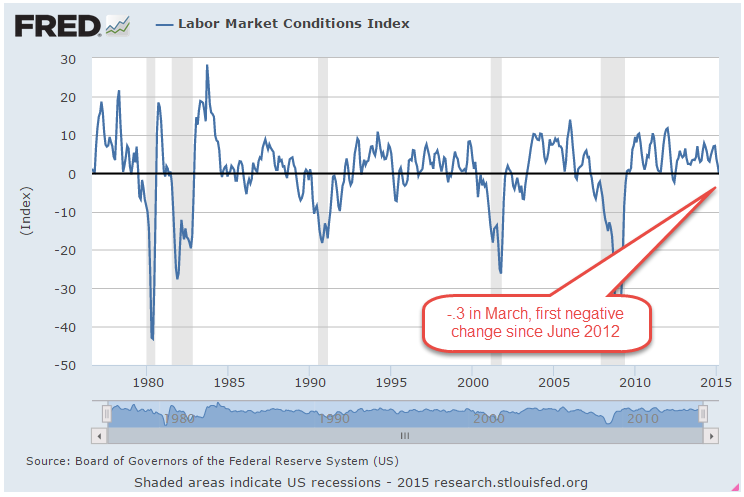
The market seemed to wake up Monday morning on the wrong side of the bed.  The Federal Reserve updated their Labor Market Conditions Index, scoring the month of November with a tepid 2.9, a sobering counter punch to the previous Friday’s report of 321,000 job gains in November.  Too many part time workers, too many long term unemployed, a rate of unemployment that was too high among minorities, those in their twenties and those without a college education.

ISM’s monthly reports showed continued strength in both manufacturing and the services sector. The composite CWPI eased just a bit from the historic highs of the past two months.

The key components of the manufacturing index, new orders and employment, remained strong or robust.  The prices component showed a steep dive from expansion to contraction, 53.5 to 44.5.  George wondered if the falling price of oil had anything to do with this change.  New orders in the services sector grew even stronger while employment eased just a bit and was also continuing a strong expansion.

On his way to Home Depot on Tuesday morning, George filled up his SUV for just under $50.  When had that happened last he wondered.  2009, maybe?  George remembered the lead up to the 2012 elections. “Gas was $1.50 when Obama came into office,” he would hear on a conservative talk show, “and now it’s more than double that. Obama is hurting working families.”  As though Obama, or any President for that matter, had much to do with the price of gas.  Most talk show hosts counted on the fact that their audience was, well not stupid, as Jonathan Gruber had quipped when talking about Obamacare at a conference, but poorly informed.

The market had opened up that morning in a particularly foul mood after China tightened lending criteria so that Chinese investors could no longer use low-grade corporate debt as collateral for loans.  Overnight the Shanghai market lost more than 5% (WSJ ).

The EIA projected that U.S. oil production would rise in 2015 even as oil prices went lower.  Lower prices might curb new drilling but once the wells were drilled, the cost of production was fairly low.  The drop in gas prices put some extra money in most people’s pockets.  The EIA estimated that a gallon of gas would average about $2.60 in 2015, almost a $1 lower than the $3.51 average in 2013.

The continuing fall in oil prices contributed to another drop in the market on Wednesday, erasing the gains of the past month.  To sell or not to sell, that is the question, George thought as the volatility in the market continued to climb, rising more than 50% in the past week.  But he hemmed and hawed, then decided to replace the fence post in the back yard as the antidote to his indecision.

In an economy dominated by consumer spending, the monthly retail sales report and the employment report are probably the two most influential gauges of the strength of the economy.  Thursday’s report on retail sales was a huge positive, showing a rise of .7%.  On an annualized basis, that was an increase of more than 8%.  People were evidently spending the money they were saving at the pump.  The market opened higher and climbed up above Wednesday’s opening price.  Great stuff, George thought, then watched as the positive mood vanished and the market started sinking.  He must have made some sound because Mabel called out asking him if he was OK.  George realized that the early morning run up in prices was traders covering their short bets.  The underlying sentiment was still negative.  A strong employment report last Friday and now a strong retail sales report was having little effect on the mood of the market.  George decided to get out of the way of the darkening mood and sold the equity index he’d bought in mid-October.

The market continued to follow oil prices down on Friday.  George was pleased to find that the long term Treasuries that he had bought last week were up a few percent.  Glancing back at the beginning of the year, he saw that long term Treasuries (TLT) were up an unbelievable 20% so far this year.  Back in January many had projected higher interest rates toward the end of 2014, making long term Treasuries less attractive.  The equity market was up 10% for the year despite the recent change in mood.  Two types of investment that often moved opposite each other had moved in the same direction.  George smiled as he remembered something his  childhood baseball coach would say, “If it ain’t one thing, it’s the other, and sometimes it’s both.”  Which was just another way of saying not to put all your eggs in one basket.

Gangbusters!

December 7, 2014

On Monday, George intended to put the $50K from the CD into the bond market. He couldn’t decide between a long term bond index like Vanguard’s BLV or TLT, the ETF that tracked 10 year Treasury bonds. Both the bond and stock markets opened lower in the morning which confused him and he did nothing. Gallup released their monthly survey of consumer spending for November, showing a respectable gain of more than 4% over last November.

Tuesday’s report of auto sales in November was strong.  Total vehicle sales topped 17 million on an annualized basis. Auto manufacturers reported particularly strong sales over the Thanksgiving holiday.  SUVs were big sellers and that was a double plus for auto companies because those vehicles had larger profit margins.  The American car buyer has long had a short memory.  Six months of falling gas prices prompted many to abandon their economical cars and wrap themselves in a big bubba vehicle.

Construction spending was up 1.1% from the previous month and 3.3% above last October.  The economies of Europe may have slipped into neutral or recession but the U.S. economy was chugging along.  The upbeat reports gave the stock market a minor boost but there was little selling of Treasuries, indicating a growing split in sentiment among investors.  George decided to put his and Mabel’s CD money into TLT.

On Wednesday, the Centers for Medicare and Medicaid Services released their annual report on health care costs.  Spending had increased only 3.6% in 2013, the lowest increase since 1960, and the fifth year in a row that spending had grown less than 4%.  Out of pocket expenses had risen from $293 billion in 2007 to $339 billion in 2013, a 16% increase over six years.  Before the recession, George could remember years when spending rose almost that much in a single year.  CMS reported that consumers’ out-of-pocket spending was only 3.2% of charges, less than the 5.9% of charges in 2007.

CMS published a historical table that caused George to raise both eyebrows.  In 1960, Americans spent $125 ($967 in 2012 dollars) per person on health care. In 2012, that figure had grown eight-fold to $7533 per person.  Administrative and public health programs added another 15% to those costs.  In 2013, the total cost per person was over $9500 for a whopping national total of $2.9 trillion spent on health care, almost 18% of GDP.

While families were shelling out more for health care, companies were grabbing a larger share of the economic pie.  As a percent of GDP corporate profits had been trending upward since 1990.

The private payroll processor ADP reported private job gains of 208,000, slightly below expectations but still above the 200,000 mark considered a healthy job market. Later that day came the announcement that a Staten Island grand jury decided that there would be no indictment in the death of Eric Garner.  Caught on video, five or six officers had surrounded the man to arrest him for selling bootleg loose cigarettes.  One of the officers put a choke hold on the unarmed Garner, restricting his breathing till he died of asphyxiation.

Later that day, four Denver bicycle cops were escorting a parade of students protesting the grand jury decision in Ferguson.  Acting as a buffer between the students and traffic on the busy street east of the Capitol, the officers were struck by a Mercedes as it ran through an intersection.  The Mercedes dragged one of the officers about thirty yards and that officer was taken to the hospital in critical condition.  On the evening news, George and Mabel learned that the driver of the Mercedes might have been having a seizure when he hit the officers.

Late Thursday morning, George was focused on several economic reports.  Since 2010, the polling firm Gallup had conducted a simple employment survey, called P2P, that counted the number of people who had worked for money in the past week or had looked for work in the past week.  Gallup reported the lowest unemployment rate, 6.2%, since the poll began.  New jobless claims were one again just under 300,000, indicating that the previous week’s 314,000 might have been an anomaly.  The 4 week average of new claims was still below 300,000.

Friday morning the reporters dusted off their sports dictionaries as they searched for words to describe the monthly labor report from the BLS.  Blockbuster.  Gangbusters. Blowout numbers. Spectacular.  Amazing.  George poured another cup of coffee. Yes, 321,000 new jobs sounded great!!! Too great. George got out his magnifying glass, put on his Sherlock cap and went hunting.  First of all, ADP had reported 208,000 private job gains.  The BLS report included new government jobs which the ADP did not include.  So back out the 7000 new government jobs to get private job gains of 314,000 according to the BLS.  Paging Dr. George, number surgeon.  He took out his skeptical scalpel. Take the average of the two estimates, which was 314 +  208 = 522, divided by 2 = 261.  Add back in the 7000 government jobs and probably the more accurate figure was close to 270,000 – 280,000.  September’s job gains had been revised up 20,000 by both ADP and the BLS. The BLS also revised the job gains of October,  getting closer to the averaging method that George used. Sacre bleu!  Averaging really works!  George was a big believer in averages.

Anyway, the employment report was strong, just not as fantastic as it first appeared. Average monthly job gains for the past year had been about 230 – 240,000.  George picked up his magnifying glass.  Hmmm, he said.  Retail job gains were 50,000, far above the 22,000 average of the past year.  At least 20,000 of those job gains were temporary seasonal gains.  Let’s be generous and start with 280,000 jobs. 280 – 20 = 260.  Now job gains were approaching the average of the past year.

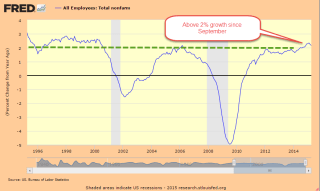
Still, the yearly growth in employment was climbing toward 2%, slowly but surely getting stronger.

Professional and business service jobs had been a leading sector for the past few years and were especially strong this month at 86,000, way above the average gains of 50 – 55,000.  George raised a skeptical eyebrow.  A closer look showed that the strong gains were particularly strong in bookkeeping and accounting.  Take out 20,000 temporary tax jobs, George thought, and now his count was down to 240,000.  Boy, this was quickly becoming an average employment report.

Yearly gains in hourly earnings for the average worker were just under 2.2%, just barely ahead of inflation. For all workers, the gains were 2.1%.

George put away his magnifying glass and put on his rosy glasses.  The average hourly work week had increased .1 hour over the past month, a good sign.  However, that was also the yearly gain.  Not so good.  George cleaned his rosy glasses.  The gains had been fairly broad and the core work force aged 25 – 54 had increased to nearly 96 million.

The construction and manufacturing sectors reported strong gains.  Although the headline unemployment rate remained the same at 5.8%, this rate was more than 1% below last year’s rate, a sign of a relatively healthy labor market.

A wider measure of unemployment, the U-6 rate, had declined .1% but was still above the rates in the mid-2000s.  George needed a better pair of rosy glasses.

George checked to see if the Federal Reserve had updated their Labor Market Conditions Index but that would probably come next week.  The market had risen a few tenths of a percent since the high of two weeks ago.  According to a Fact Set report, earnings growth for the fourth quarter had been revised down from 8.3% to only 3.4%.  After rising up almost 14% since the mid-October trough, the SP500 had stalled despite a number of positive reports.  Treasury bonds had lost a few percent in price since mid-October but had stayed relatively strong, indicating some skepticism toward any further stock gains.  The stock market seemed to be treading water ahead of the December 11th deadline for Congress to pass a spending bill.  Despite promises that there would be no government shutdown this time, investors might be a bit less confident in the dependability of promises from the Republican leadership.