Circumstance

May 21, 2017

Last week I mentioned the 20 year CAPE ratio, a modification of economist Robert Shiller’s 10 year CAPE ratio used to evaluate the stock market. This week I’ll again look at equity valuation from a different perspective.  The results surprised me.

The date of our birth is circumstance.  When we retire is guided by our own actions and the circumstance of an era. We have no control over market behavior during the twenty year savings accumulation phase before we retire or the distribution of that savings during our retirement.   Let’s hope that we live long enough to spend twenty years in some degree of retirement.

The state of the market at the beginning of the distribution phase of retirement can have a material effect on our retirement funds, as many newly retired folks found out in 2008 and 2009.  Some based their retirement plans on the twenty year returns  prior to retirement.

I’ll use the SP500 total return index ($SPXTR at stockcharts.com or ^SP500TR at Yahoo Finance) to calculate the total gain including dividends. The twenty year period from 1988 through 2007 began just after the stock market meltdown in October 1987 and ended just as the 2007-2009 recession was beginning in December 2007. The total gain was 742%, or 11.3% annualized. Sweetness! Sign me up for that program.  Those high returns led many older Americans to believe that they didn’t need to accumulate more savings before retirement.  Then came the double shock of zero interest rates and a 50% meltdown in stock market valuation.

Now let’s move that time block one year forward and look at the period 1989 through 2008. Still good but what a difference one year makes. The total gain was 404%, or 8.4% annualized. That’s a drop of 3% per year! Investors missed the 16% bounce back in 1988 after the October 1987 crash, and the time block now included the 35% meltdown of 2008. There was even more pain to come in the first half of 2009 but I’ll come back to that.

1995 through 2014 was a good period with total gains of 550%, or 9.8% annualized. Shift that time block by two years to the period 1997 through 2016 and the gains fall off significantly. The total gain was 340%, or 7.7% annualized.

We can make a rough approximation of total returns during the late 1970s and into the 1980s, an ugly period for equities. In 1980, someone quipped “Equities are dead.” Twenty year periods ending during this time did not fare so well but still notched gains of more than 6%. Bonds, CDs and Treasuries were paying far more than that at the time. In today’s low interest environment, 6% seems a lot better than it did during the double digit inflation of 1980.

In past weeks I have written about the overvaluation of today’s stock market based on trailing P/E ratio and the smoothed 10 year CAPE ratio. Let’s look at the current valuation from the perspective of this twenty year return. It would come as no surprise that the total twenty year gain hit a low at the end of February 2009 when the market was about a 1/4 of its current valuation. That 20 year annualized gain was 5.7%. What surprised me was that the current valuation shows the same 20 year gain! Using this metric as an evaluation guide, the market sits at a relatively low level just like it was in 1988 and 1989.

The historical evidence shows that stock returns may be erratic but consistently make over 5% over a twenty year retirement period. Those who are newly retired or about to retire might understandably desire more safety. The safest approach is not to suddenly shift one’s portfolio entirely to safe assets.

///////////////////////

Income Inequality

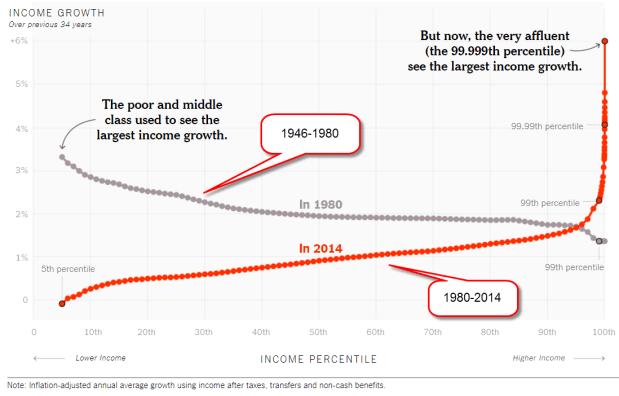
Much has been written about the growth of income inequality. The GINI coefficient is the most popular but there are other measures (for those who want to get into the weeds of inequality measures). The Social Security Administration offers a simple indicator of the trend. They track the average and median incomes of millions of earners every year.

When the median and average are fairly close to each other, that indicates that the numbers in the data set are uniformly distributed. As the ratio percentage of the median to the average falls, that indicates that a few big numbers are raising the average but do not raise the median.

Here’s a simple example of an evenly distributed set. Consider a set of numbers 1, 2, 3, 4, 5, 6. The average is 3.5. The median is also 3.5 because there are three numbers in the set below 3.5 and three numbers above 3.5.  The percentage of the median to the average is 100%.

Let’s consider an unevenly distributed set: 1, 2, 3, 4, 5, 12. The median is still the same value as the earlier example: 3.5. But the average is now 4.5. The ratio of the median to the average is 3.5 / 4.5 = about 78%.

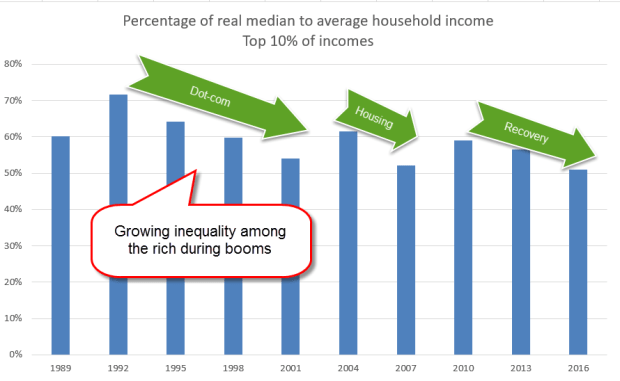
The ratio of the median to the average income has fallen from 71% in 1990 to 64% in 2015. This indicates that there is a growing number of large incomes in our data set.

SSAIncomeAvgMedian
Here’s the data in a graph form

SSAIncomeAvgMedianGraph
Median wages have doubled, or grown by 100%, while average wages have grown by more than 150% in the last quarter century.

Next week I will look at a hypothetical income tax proposal based on income. It might just blow your mind.

///////////////////////

Dividend Payout Ratio

FactSet Analytics grouped dividend paying stocks in quintiles (20% bands) by the dividend payout ratio (Chart). This is the percentage of profits that are paid to shareholders in the form of dividends. Over the last 20 years of rolling one month returns the stocks that had the highest and lowest payout ratios had the lowest total return. Think about that. Both the highest and lowest quintiles did the worst. What performed the best? Those stocks that were in the middle quintile, the companies who balanced their profit distributions between investors (dividends) and investment (future sales and profits).

//////////////////////////

CWPI

Each month I compute a Constant Weighted Purchasing Index built on a combination of the two Purchasing Manager’s surveys (PMI) each month. For the six month in a row, this composite has shown strong growth and the three year average first crossed the threshold of strong growth in January 2015.

A sub-index composite that I build from the new orders and employment components of the services survey (NMI) shows moderate growth. Its three year average has shown moderate growth since early 2014.

////////////////////////

Surprises

May 14, 2017

Surprises, the good, the bad and the ugly. When we are in retirement, we are less resilient when the bad or ugly surprises happen. There are event surprises and process surprises. An event surprise might be the damage and loss from a weather related event. A process surprise can be even more deadly because it happens over time.

Misestimates and unrealistic expectations are two types of process surprises. Let’s look at the first type – misestimates. In a recent survey, Boomers were asked to estimate the percentage of income they would have to spend on healthcare. The average estimate was a bit less than 25%. The actual average is a third of retirement income. Let’s say a couple gets $4000 in monthly income from Social Security, interest and dividends. If they had budgeted $1000 (25%) of that for healthcare costs, then discover that they are spending over $1300 a month, that extra cost will slowly eat at their savings base.

A good rule of thumb is to estimate that, in the first few years of retirement, we will spend as much if not more than we spent before we retired. If we are wrong and we spend less, that’s a good surprise. In those first years we may find that we are spending more in one area of our lives and less in another.

The second type of process surprise – unrealistic expectations. Let’s say I expect to make 8% per year on my savings with a small amount of risk. People with a lifetime of experience in managing money struggle mightily to accomplish this and all but a few fail. Either they must take on more risk or lower their expectations of return.

Vanguard and other financial companies provide the expected risk and returns of several different allocations over many decades. Here‘s a chart at Vanguard that does not include a cash allocation in its calculation.  These long term calculators have another drawback: they include rather unusual times in history – the 1930s Depression era and World War 2.

We could use the last twenty years of actual returns to guide our expectations for the next twenty years. In past articles, I have linked to the free tools available at Porfolio Visualizer and there is a permanent link on the Tools page.

I select 1997 for the starting year and 2016 for the ending year. I leave the default settings at the top of the screen alone for now. If I input 40% into the U.S. Stock Market, 40% into the Total U.S. Bond Market, and 20% into Cash, I have chosen a conservative allocation – 40/40/20. I click the Analyze Portfolios button and see that the return was a bit over 6% in the CAGR (Compound Annual Growth Rate) column. How likely am I to achieve 8% over the next 20 years? Not very likely.

I’ll input a moderate allocation of 60% stocks, 30% bonds and 10% cash. The result is an almost 7% annual return so I am getting close to my 8% but there was a nasty time when I lost 1/3 of the value of my portfolio. If I am 70 years old, how comfortable would I be if I watched my portfolio sink almost 33%? I think I would have some restless nights worrying whether I would have to go back to work. How up to date are my skills? Would my prospective employer allow me to take a short nap in the afternoon? I feel so rested and ready to rock and roll after a nap. Well maybe not.

Wait a minute, I tell myself. The past 20 years included the busting of a tech bubble, 9-11 and the 2008 financial crisis. Two of those were rather extraordinary events. So I pick a different 20 year time period, 1987 – 2006. That still includes some serious shocks like the tech bubble and its pop, as well as 9-11. My conservative allocation of 40/40/20 made 8-1/2% CAGR and the moderate allocation of 60/30/10 made 9-2/3%.

But I’m not happy with the risk. I could even decrease my risk and make my 8% return by choosing a very conservative allocation of 30% stocks, 50% bonds and 20% cash. My portfolio lost less than 10% in its worst year ever – the maximum drawdown. If I go to Vanguard’s risk return chart they estimate a 7.2% average return over 90 years, which included a horrible depression that lasted a decade and a world war. It’s to be expected that my 20 year period 1987 – 2006 would do a bit better than the 90 year average because the catastrophic shocks are not included.  I think my 20 year period is more representative of the risks I will face in the next 20 years.

I could have picked the 20 years from 1981-2000 and that would have been unrealistic. The conservative allocation earned more than 10% and the annual return on the moderate allocation was almost 12%.

So I have now set what I think is a realistic 20 year time frame that gave me the historical risk and reward that met my expectations. But that’s not realistic. Not yet. I am going to be taking money from this portfolio to supplement my retirement income. So now I go back up to the top of the screen where the defaults are and under “Periodic Adjustments” I select the “Withdraw fixed percentage” option and under that I input 4.0%. This is supposed to be the safe withdrawal percentage. The next row is the “Withdrawal frequency.” I’ll select Annual.

Since I am now taking cash out this portfolio, I will turn to the IRR column of the results because the Internal Rate of Return calculation considers cash flows. My very conservative allocation of 30/50/20 has an IRR of almost 8.5% with a drawdown of less than 15%. The column that says “Final balance” shows that I have more than double the money I started out with and I have been able to withdraw 4% per year. I would have liked to get the drawdown below 10% but I think I can live with 13-1/2%. I’ll be worried but I don’t think I will lose sleep over it. So now I have made what I think is a reasonable expectation of risk and reward based on historical returns.

There’s one last thing I need to do. I know that the 20 year period from 1929 to 1948 was bad but I can’t check that in Portfolio Visualizer because the year selection only goes back to 1972. So I select a really bad ten year period, 2000 – 2009. This was from the heights of the dot.com boom to a short time after the financial crisis. After taking 4% per year, the IRR on my very conservative allocation was 4% and I still had the money I started out with at the beginning of the ten year period. I could probably withstand a 20 year period like this as long as I stay true to my allocation.  But, the maximum drawdown (see here) was 21%, something that I am not comfortable with.

I am left with some hard choices.   In the case of another bad ten year period, I can lower my withdrawal percentage a bit or I can learn to have faith in the allocation process and accept the drawdown.  I have done this with a free tool. I could pay for more sophisticated tools that gradually transition from one allocation to another allocation over a 20 year period.  That would be more realistic still since I will probably get more risk averse as I get older. At least this gets me started.

We often can’t avoid the suprise events. Some surprises are both event and process like the diagnosis of a  life-threatening illness. We can understand and be alert to the process surprises that we may inflict on ourselves. Understanding involves some frank self-assessment and difficult questions. Am I prone to wishful thinking? Do I overestimate my tolerance for risk? How well do I live with the consequences of my decisions?

/////////////////////

CAPE

A few weeks ago I mentioned that I might calculate a 20 year CAPE ratio. The CAPE that Robert Shiller uses is a ten year period. As of the end of 2016 the 20 year CAPE was 31 vs the 70 year average of 21. Whichever calculation we use, the market is priced a good deal above average. The 20 year CAPE first crossed above the average in the late summer of 2009.

//////////////////

California

Over the past 5 years California’s economy has grown faster than any other developed country except for China. Bloomberg article

Connector Jobs

May 7, 2017

Later in this article I’ll take a long term look at connector jobs and how they can help us understand the swings in the economy as a whole.  Last week I mentioned that I might figure and graph a 20 year CAPE ratio for the past few decades.  I will post that up next week. First let’s look at the whole economy.

The initial estimate of first quarter GDP was released this week. Another quarter of meager growth. Here’s a chart of real, or inflation-adjusted, GDP growth per capita. During this recovery there has been only one quarter when annual growth has crossed the healthy benchmark of 2.5%.

GDPPerCap201703

A working paper by economists at the NBER estimates a 2.1% growth rate in OECD countries (which includes the U.S.) for the next few decades. An aging population is the major contributor to the the 25% decline from the 2.8% growth of the post-WW2 era. Promised benefits to those in OECD countries will stretch national budgets in a lower growth environment.

The Trump administration has one mandate – stronger growth – and will be judged by how well it can maintain its focus on that goal. This current second quarter of a new administration is the first one that voters count. Voters and investors will be keenly watching to see if Republicans have anything of substance behind the campaign rhetoric.

///////////////////////

Labor Report

In contrast to the slow GDP growth comes the news that payroll growth is strong. The average of the BLS (includes government jobs) estimate and the ADP (private only jobs) was a 203,000 gain in April.

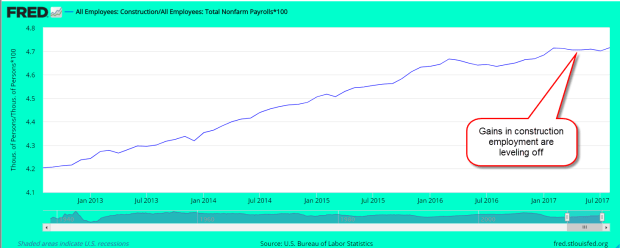
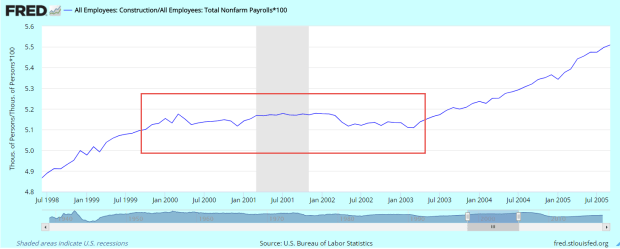
Here’s an indicator that has proved to be reliable for six decades. As long as the growth in construction jobs is greater than the percentage growth of all jobs, the economy is healthy. An investor who reduced their equity holdings when construction job growth declined faster than overall employment (blue line crossing below declining red line) and overweighted equities when construction job growth was faster (blue line crosses above rising red line) would have done quite well.

ConstVsPayems201705

This might seem like a puzzle to those who do not work in real estate or construction. How does such a small part of the economy – less than 5% – provide such a key indication of the health of an economy? Because construction jobs are connector jobs. Remember Tinker Toys? Construction jobs are the round hubs with the holes in them.

They connect working people who are buying and renting homes.
They connect businesses leasing offices and stores.
They connect politicians and taxpayers to build and repair infrastructure.
They connect investment money and businesses wanting to expand.

When construction jobs decline, we can guess that new home sales are weakening, that demand for office and retail space is slackening, that tax collections are diminishing and government budgets tightening.  Factory, retail and office building construction decline as caution plays a stronger hand among institutional investors.

New unemployment claims remain at historic lows. Continuing claims for unemployment insurance have not been this low since June 1969.

UnemplClaimsPctPayems201705

The number of people voluntarily qutting their jobs for another job (the quit rate) is near the highs seen in 2005 through 2007.

People working part time jobs because they can not find full time work have declined since their peak in September 2011 but are still high. Many employers in retail and restaurants use part time employees to meet daily peaks and ebbs in the customer flow. Benefit costs for part time employees are less than full time. Even in a booming economy like Denver, people in their 20s with a college or two year degree may have to put together two or more part time jobs to make ends meet.

Throughout most of this recovery the weekly earnings of non-government employees has struggled to grow at more than a 2.5% annual pace, far below the plus 4% growth of the middle of the 2000s. On an even more sobering note: the median real weekly earnings of full time black workers is 20% less than all full time workers.

For decades to come, both the financial crisis and the recovery will be studied and written about.  Scholars will try to understand the trend to part time jobs and the slackening wage growth.  The total cost of an employee includes benefit costs and mandated payroll taxes.  As medical insurance premiums continue to rise faster than inflation,  the total cost of an employee has increased faster than inflation.  Employers have compensated by reducing the growth of the wage component of total cost.  Secondly, they have reduced benefit costs by employing more part timers where possible.

Trump was elected on the campaign promise that this so-so rate of growth would not be the “New Normal” under his administration.  Walking that talk may be much harder than he thought, or that anyone thought.

///////////////////////////

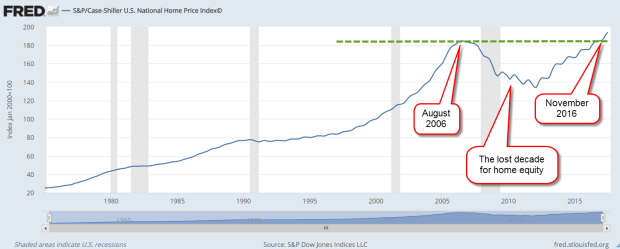
Today I heard some one say, “I’m afraid that if I don’t buy a house soon, I will be priced out of the market.” When have I heard that before? It was 2006, at the height of the housing boom.

The Cycle

April 30, 2017

This week I’ll look at the savings, retirement and asset cycle, which all have a similar lifetime. Let’s look first at asset pricing.

Long term moving averages can serve as a safety benchmark for asset prices, and a 50 month, or 4 year average, is one such average. If the price falls below that very slow moving average, there has already been a sizeable repricing of that asset and there may be more to come. It should prompt some caution or review.

Here’s a recent example.  In the summer of 2011, a basket of Brazilian stocks (EWZ) crossed below its 4 year average.  Six years later it is just nearing that long term benchmark. Its been a long hard slog for long term holders of Brazilian stocks, and supports the recommendation that an investor keep funds needed in the next five years out of the stock market.

Emerging markets (EEM, VWO, VEIEX) just crossed above their 4 year averages and are now at the same price as they were in August 2008.  This nine year “flatline” period came after a growth spurt from 2003 to 2007 when emerging market prices grew at 36% per year!  Even after nine years of no growth, an emerging market index has returned 10.5% annually in the the past 14 years.

The S&P500 has fallen below its 4 year average twice in the past three decades. Once was during the dot com bust in 2002 and the financial crisis in 2008. Each time, the index stayed below that benchmark for two or more years. During the 1969 – 1982 bear market, the SP500 fell below that benchmark four times! During that downturn, the index gained only 15% in 14 years. After adjusting for inflation, the loss was 40%,  or 3% per year.

Bond prices have been more stable and provide an anchor to a portfolio. Let’s compare the stock market to Vanguard’s total bond market index fund (VBMFX ). In the last three decades, the fund has NEVER fallen below its 4 year average. Dividend paying stock stalwarts like Johnson and Johnson (JNJ) can also serve as anchors since they fall below their benchmark less frequently than the SP500 index.  When these stable stocks do fall, the price rebounds more quickly than broader indexes because investors are attracted to fairly reliable sales and dividends.

So how does a casual investor without a charting program chart a 4 year average? Stockcharts.com has free charts available. In the example below, I input “SPY,” a popular ETF that tracks the SP500 into the “Enter A Symbol” box on the upper right portion of the screen, then I clicked the Go button. Stockcharts displayed a daily chart for this ETF with default 50 and 200 day averages. Above the chart, I clicked the selection box from Daily to Weekly and pressed the Update button. I left the default 50 and 200 averages alone. The red line is now the 200 week, or approximately 4 year average. The blue line is the 50 week, or one year, average. The chart below is an example.

SP500ROC201704

This particular screen shot includes a Rate of Change indicator in the pane below the chart. Set at 100 weeks, it shows the percentage gain over two years.  Both gold (GLD) and mining stocks (XME) are struggling to get back above their 4 year averages.  You can change the symbol and compare their graphs.

In the earlier example, emerging markets had a five year spurt upwards, then a nine year flatline. Let’s look at a broad index like the SP500 in inflation adjusted dollars and we will see a similar pattern. $100K invested in the SP500 index in January 1997 was worth $183K in real dollars, real buying power, in April 2000. That was almost a doubling in real value in a small time frame. Easy money!

In 2012, twelve bruising years later, that inflation adjusted portfolio value FINALLY rose above $183K. Here is a free chart from PortfolioVisualizer.com

SP500GrowthInflAdj1997-2016

In the past four years, we have had another 62% spurt upwards in real value. The length of these spurts and flat periods are unpredictable, but the flat periods last longer than the spurts.

Let’s go back to the previous twenty year period, from 1977 – 1997.  In the first four years, from 1977 – 1983, the SP500 flatlined. In the following 14 years, the index grew by 570%!  (Exclamation marks for these growth spurts.)

SP500GrowthInflAdj1977-1997
We can see now that the strong asset price growth from 1997 to April 2000 was in addition to the extraordinary price growth from 1983 to 1997.  But doesn’t this example disprove the point I made earlier that flatline periods are longer than the growth spurts?

Let’s look back to those years before 1977 and we will see one of the reasons for that long growth period of the 1980s and 90s.  The six year flatline from 1977 – 83 was the tail end of a much longer period of flat or declining asset prices that lasted for 14 years, from 1969 through 1982. The introduction of tax deferred IRA accounts brought many individuals into the stock market during the 80s and 90s and helped to lift stock prices.  The introduction of the internet in the early 90s helped fuel a boom in asset prices much like the development of radio did in the 1920s.

Let’s turn from the long term 15+ year cycle of the stock market to the savings and retirement cycles. We spend at least forty years working. We may have just the last twenty years of our working career to save up for retirement. We hope to spend fifteen to twenty years in some stage of retirement.

We do not control when we are born nor the timing of these long term asset pricing cycles.  An awareness of these cycles may help guide us to wiser allocation choices.

The Nobel economist Robert Shiller builds an inflation adjusted ten year P/E ratio (CAPE) that is meant to smooth the ups and downs of company earnings. If I get some time next week, I may construct a 20 year ratio that corresponds to the 20 year cycle of 1) saving for retirement, 2) spending in retirement, and 3) the long term ebb and flow in the stock market.

////////////////////

Margin Debt

Investors meeting certain liquidity requirements can borrow money from their broker to buy assets, including stocks.  When stock prices start falling, investors without sufficient collateral in their brokerage accounts to cover the paper losses from falling stock prices may be subject to what is called a margin call.  The broker simply sells some of the client’s stock to replenish collateral.

Here’s an example and I will make the figures simple to avoid some of the complex rules involved.  An investor has $80,000 in stocks that she has bought and paid for.  She applies for a margin account with her broker who agrees to loan her $100,000 to buy other assets.  Thinking that the coming tax cuts will boost stock prices in the coming months, she buys $100,000 on margin in SPY, an ETF that replicates the SP500 index. Two weeks later, the European Union moves to disband in the coming months which makes investors very nervous and the stock market drops 20% in one day.  Yes, I told you I would make it simple.  The $80,000 in stocks that the investor owns outright is now worth $64,000 and the $100,000 of stocks she just bought on margin are worth $80,000.  The brokerage automatically sells $20,000 of the stock at the lower price to cover the shortfall in collateral. This is known as a margin call. One margin call does not create a selling wave.  Thousands of margin calls puts more downward pressure on stock prices and they continue to fall.  This again requires more selling to meet margin calls.

Because margin debt can ignite a selling frenzy in a crisis, the amount of margin debt is monitored.  Two years ago, the level of margin debt surpassed an earlier peak in 2000 at the height of the dot com bubble.  A graph from Doug Short at Advisor Perspectives shows the tight correlation between stock prices and margin debt.  After a brief decline, debt levels have again hit an all time high in real dollars.

There are a number of volatile situations around the world that could start a selling wave.  The level of debt will naturally accelerate that selling.  Now comes the news that there is a pool of margin debt that is not even reported and may add another 20 – 40% onto the reported total.  Here’s an article from Business Insider.

Guessing the Future

April 23, 2017

Human beings have an ability to foretell the future, or at least some people think so.  A more accurate description is that we predict the likelihood of future events based on past patterns.  Index funds average the predictions of buyers and sellers in a particular market.

During the recovery most active fund managers have underperformed their benchmark indexes. Standard & Poors, the creator and publisher of many indexes, provides a quick summary in their SPIVA spotlight. In the past five years, 88% of active fund managers have underperformed the SP500.  In a random world, I would expect that 50% of active fund managers would beat the index, and 50% of managers would underperform the index because the index is an average of all those buy sell decisions.

The 1% higher fees charged by active fund managers contribute mightily to this underperformance. Using long term averages, we expect that a third of active fund managers would beat their benchmark index.  The current percentage is only 12%. It is likely that the law of averages will eventually exert its pull.

Index funds mechanically rebalance regularly. Let’s look at a real life example.  The pharmaceutical giant Johnson and Johnson is a member of both the SP500 and the smaller group of core stocks that make up the Dow Jones index.  This week the company  reported first quarter revenues that were below expectations, and sellers promptly knocked 3% off the stock price.  Because most SP500 index funds are market weighted, index funds that mimic the weighting of the stocks in the index would buy and sell stocks in the index to capture these changes.

Because index funds are averaging the decisions of all stock investors, they should underperform. After all, the index funds are buying those companies that everyone else is buying, and selling companies that everyone else is selling.  Index funds are buying high and selling low, creating a drag on performance that is overcome by the lower fees charged by these funds.

In an article last fall in the Kiplinger newsletter, Steven Goldberg makes the case for a mix of both index and active funds.  Research shows that active fund mangers do better when an index does poorly.  It’s worth a read.

The index fund giant Vanguard is featured in a NY times article. John Bogle founded Vanguard based on his thesis that a passive approach to investing and low fees would reward most investors over the long term.

///////////////////////

Correlation, not Causation

When the stock market crashed in 1929, the unemployment rate was less than 3%.  A booming economy during the 1920s lifted demand for labor, while severe immigration restrictions enacted in 1924 reduced the supply of workers.

Unemploy1929-1942

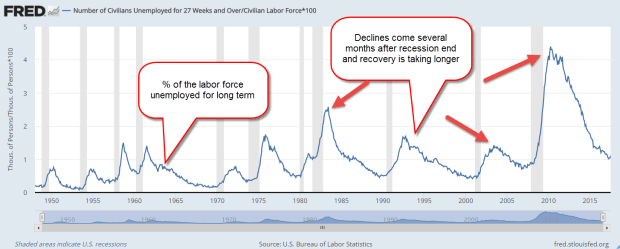
The unemployment rate was 6% when the market crashed in October 1987 and again in September 2008. There seems to be a weak connection between unemployment and severe market crashes.  However, there is a consistent correlation between the change in number of unemployed and the start of recessions.

UnemployChange

A yearly increase in the number of unemployed on a percentage basis indicates a fundamental weakness in the economy.  Sometimes, the change reverses as it did in early 1996, at the start of the dot com boom, or in the mid-eighties after a downturn in oil and housing exposed a banking scandal. These two periods are circled in blue in the graph above.

Often the economy continues to weaken, more people lose their jobs, GDP falters and the economy slides into depression.

Because we cannot rely on just one indicator as a warning signal, we can chart the amount of production generated by each person in the labor force.  The civilian labor force includes both those who are working and those who are actively looking for work.  A growth rate below 1% indicates some weakness.  Using both the change in unemployment and the change in production helps filter out some of the noise.

While production growth may be faltering, the current unemployment level is not worrying.

///////////////////////

Pay Attention to the Pros

Institutional buyers and sellers of Treasury bonds will usually let the rest of us know when they are worried about a recession.  In a middling to healthy economy, Treasury buyers will demand a higher interest rate for a longer dated bond.  Subtracting the interest rate on a shorter term two year bond from a long term ten year bond should be positive.  In a “normal” environment, a 10 year bond might have an interest rate of 3% and a two year bond an interest rate of 1%.  The difference of 2% would be expected.  However, a negative result indicates that buyers want more interest from short term bonds because they are more concerned about short term risks.  As we can see in the chart below, a negative result precedes a recession by 12 to 18 months.  The current difference shows no indication of concern.

Guessing the future is not divination, nor is it perfect.  Retail investors may not have the time or expertise to estimate future risk, but we can study those who make it their business to manage risk.

The Long Game

April 16, 2017

Happy Easter!

Successful investing requires a far sighted vision. At the end of each year Vanguard sends its customers their long term outlook. This last one contained a few caveats: “the investment environment for the next five years may prove more challenging than the previous five, underscoring the need for discipline, reasonable expectations, and low-cost strategies.”

Vanguard’s ten year estimate of annualized returns is about 8% for non-US equities, 6.5 – 7% for the US stock market, 5% for REITs (real estate) and commodities, and 2% for bonds.

Vanguard’s team projects that a diversified portfolio of 60% stocks/ 40% bonds will return 5.6% annually over the next ten years. An agressive 80/20 mix they estimate at a 6.6% return, and a very conservative 20/80 mix at about 3.3%. Insurance companies typically adopt this safe approach. (Source)

/////////////////////////

ANNUITIES vs. MANAGED PAYOUT?

Investors near or in retirement must often turn to their investments for supplemental income. Annuities are sold as a safe “set it and forget it” solution, but they come with upfront fees and currently pay low interest.

In early 2008, before the fianncial crisis, a 65 year old man could get an average annuity (the average of a 10 year and life) for 5.5% a year. That provided a guaranteed income that was more than the classic 4% “safe” withdrawal rate for retirees. That 4% withdrawal rule would normally ensure that a retiree did not run out of money before they died.

The average annuity rate for that same age is now half that interest rate (Source). For an investment of $100K, a 67 year old male living in Colorado can get a lifetime annuity of $7212 per year (CNN Annuity Calculator) For 14 years, the insurance company providing the annuity is essentially returning the investor’s money to them. If that male investor lived for 20 years till age 87, they would receive a total of $144K, an annual return of only 1.84%. If the retiree lived to 97, their annualized return would increase to 2.5% over the thirty year period. Clearly, an investor is paying for safety.

Wade Pfau is a CFP whom I have cited in previous blogs. Here he compares the advantages and disadvantages of investments vs. insurance. He makes an argument that an annuity that covers one’s essential needs allows a person to take more risk with the rest of their portfolio. The potentially higher return from the investment side of the portfolio can thus make up for the lower returns of the annuity, an insurance product. He does caution, however, that most annuities do not protect against inflatiion. A investor who needed $1000 extra dollars in monthly income in 2017, would need more than $2000 in 30 years at a 2.5% inflation rate.

Managed Payout?

One alternative is a managed payout fund. The Vanguard Managed Payout Fund VPGDX lists the fund’s holdings as 60% stocks with an almost 20% allocation to alternative strategies. Alternatives vary in volatility depending on the intent of the investment but let’s treat them as though they were mostly a stock, giving the fund a simple effective allocation of 75% stock, 25% bonds. This fund lost 43% from April 2008 through March 2009, less than the 50% loss of the SP500 index but not by much. A broad composite of bonds (BND) actually gained 3% in price during that time. Here is some info from the investing giant Black Rock on alternative investments.

The return of the fund since its inception in April 2008 is 4.28%. Vanguard’s broad bond composite fund VBMFX, with far less risk, had a ten year return of 4.12% and gained value during the financial crisis. Although some mutual funds have trade restrictions, the prospectus on this fund lists no such restrictions, so that one could set up a monthly withdrawal from the fund.

A Vanguard target date 2030 fund (VTHRX), which has an allocation of 70% stocks, 30% bonds, had a ten year return of 5.31%. That fund lost 45% during the eleven month downturn in 2008-2009, slightly more than the Managed Payout Fund.  The additional 1% annual return is the reward for that slightly greater drawdown. A 1/4 of that additional 1% return can be attributed to lower fees.

The advantage of a Managed Payout Fund – simplicity and regularity of income flows – does not outweigh the disadvantages of volatility and some tax inefficiency. An investor could conveniently set up a monthly withdrawal from a broad based bond fund and enjoy the same return with much greater safety of principal, lower fees, and control over the withdrawal amount, if needed.

When it comes to retirement income, most investors would prefer the simple arithmetic of our grade school years.  Both Social Security and traditional defined benefit pension programs use that kind of math.  Each year, a retiree gets ‘X’ amount that is adjusted for inflation.  No choices needed.  However, most employees today have defined contribution, not benefit, plans. A retiree owns their savings, the capital base used to generate that monthly income, and it is up to the retiree to  navigate the winding channel between risk and return.

Dance of Debt

April 9th, 2017

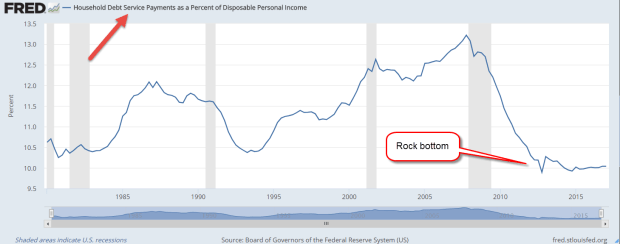
Last week I wrote about the dance of household, corporate and government debt. When the growth of one member of this trinity is flat, the other two increase. Since the financial crisis the federal debt has increased by $10 trillion. Let’s look at the annual interest rate that the Federal government has paid on its marketable debt of Treasuries. This doesn’t include what is called interagency debt where one part of the government borrows from another. Social Security funds is the major example.

In 2016, the Federal government paid $240 billion in interest, an average rate of 1.7% on $14 trillion in publicly held debt. Only during WW2 has the Federal government paid an effective interest rate that is as low as it today. World War 2 was an extraordinary circumstance that justified an enormous debt. Following the war, politicians increased taxes on households and businesses to reduce the debt. Here is a graph of the net interest rate paid by the Federal government since 1940.

InterestRate

In 2008, before the run up in debt, the interest rate on the debt was 4.8%. If we were to pay that rate in 2017, the interest would total $672 billion, more than the defense budget. Even at a measly 3%, the interest would be $420 billion.  That is $180 billion greater than the interest paid in 2016.  That money can’t be spent on households, or highways, or education or scientific research.

The early 1990s were filled with political arguments about the debt because the interest paid each year was crippling so many other programs. Presidential candidate Ross Perot made the debt his central platform and took 20% of the vote, more than any independent candidate since Teddy Roosevelt eighty years earlier. Debt matters. In 1994, Republicans took over Congress after 40 years of Democratic rule on the promise that Republicans would be more fiscally responsible. In the chart below, we can see the interest expense each year as a percent of federal expenses.

PctFedExp

Let’s turn again to corporate debt. As I showed last week, corporate debt has doubled in the past ten years.

CorpDebt2016

In December, the analytics company FactSet reported (PDF) that the net debt to earnings ratio of the SP500 (ex-financials) had set another all time high of 1.88. Debt is almost twice the amount of earnings before interest, taxes, debt and amortization (EBITDA). Some financial reporters (here, for example ) use the debt-to-earnings ratio for the entire SP500, including financial companies. Financial companies were highly leveraged with debt before the crisis. In the aftermath and bailout, deleveraging in the financial industry effectively hides the growth of debt by non-financial companies.

What does that tell us? Unable to grow profits at a rate that will satisfy stockholders, corporations have borrowed money to buy back shares. Profits are divided among fewer shares so that the earnings per share increases and the price to earnings (profit), or P/E ratio, looks lower. Corporations have traded stockholder equity for debt, one of the many incidental results of the Fed’s zero interest rate policy for the past eight years.

Encouraged by low interest rates, corporations have gorged on debt. In 2010, the pharmaceutical giant Johnson and Johnson was able to borrow money at a cheaper rate than the Federal government, a sign of the greater trust that investors had in Johnson and Johnson at that time.

Other financial leverage ratios are flashing caution signals, prompting a subdued comment in the latest Federal Reserve minutes ( PDF ) “some standard measures of valuations [are] above historical norms.” Doesn’t sound too concerning, does it?

Each period of optimistic valuation is marked by a belief in some idea. When the bedrock of that idea cracks, doubts grow then form a chasm which swallows trillions of dollars of marketable value.

The belief could be this: passively managed index funds inevitably outperform actively managed funds. What is the difference? Here’s  a one-page comparison table. In 1991, William Sharpe, creator of the Sharpe ratio used to evaluate stocks, made a simple, short case for the assertion that passive will outperform active.

During the post-crisis recovery, passive funds have clearly outperformed active funds. Investors continue to transfer money from active funds and ETFs into index funds and ETFs. What happens when a smaller pool of active managers make buy and sell decisions on stocks, and an ever larger pool of index funds simply copy those decisions? The decisions of those active managers are leveraged by the index funds. Will this be the bedrock belief that implodes? I have no idea.

Market tensions are a normal state of affairs. What is a market tension? A conflict in pricing and risk that makes investors hesitate as though the market had posed a riddle. Perhaps the easiest way to explain these tensions is to give a few examples.

1. Stocks are overvalued but bond prices are likely to go down as interest rates rise. The latest minutes from the Fed indicated that they will start winding down their portfolio of bonds. What this means is that when a Treasury bond matures, they will no longer buy another bond to replace the maturing bond. That lack of bond purchasing will dampen bond prices. Stocks, bonds or cash? Tension.

2. Are there other alternatives? Gold (GLD) is down 50% from its highs several years ago. Inflation in most of the developing world looks rather tame so there is unlikely to be an upsurge in demand for gold. However, a lot of political unrest in the Eurozone could drive investors into gold as a protection against a decline in the euro. Tension.

3. What about real estate? After a run up in 2014, prices in a broad basket (VNQ) of real estate companies has been flat for two years. A consolidation before another surge? However, there is a lot of debt which will put pressure on profits as interest rates go up. Tension.

In the aftermath of the financial crisis, we discovered that financial companies, banks, mortgage brokers and ordinary people resolved market tensions through fraud, a lack of caution, and magical thinking. Investors can only hope that there is enough oversight now, that the memories of the crisis are still fresh enough that plain old good sense will prevail.

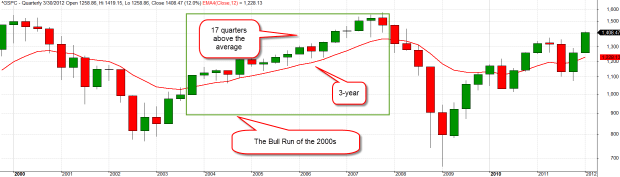
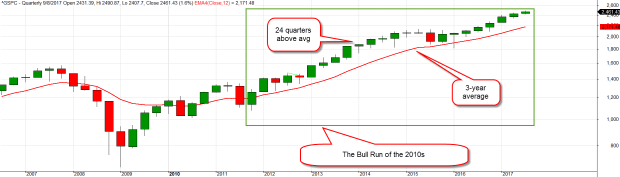
During the present seven year recovery there have been four price corrections in the Sp500 (Yardeni PDF). A correction is a drop in price of 10 – 20%. The last one was in the beginning of 2016. Contrast this current bull market with the one in the 2000s, when there was only one correction. That one occurred almost immediately after the bear market ended in the fall of 2002. It was really just a part of the bear market. From early 2003 till the fall of 2007, a period of 4-1/2 years, there was no correction, no relief valve for market tensions.

Despite the four corrections and six mini-corrections (5 – 10%) during this recovery, the inflation adjusted price of the SP500 is 50% higher than the index in the beginning of 2007, near the height of the market.  Inflation adjusted sales per share have stayed rather stable and that can be a key metric in the late stages of a bull market. The current price to sales (P/S) ratio is almost as high as at the peak of the dot com boom in 2000 and that ratio may prove to be the better guide. In a December 2007 report, Hussman Funds sounded a warning based on P/S ratios.  Nine years later, this report will help a reader wanting to understand the valuation cycles of the past sixty years.

Confidence Up

April 2nd, 2017

The Conference Board’s survey of Consumer Confidence shot up to 125, a 16 year high. Unfortunately, that previous high was set as the dot-com frenzy was nearing its end and just before the start of the 2001 recession. History could not possibly repeat itself, could it?

Confidence201703

There have been other frenzies in the past decades: the dot-com boom of the late ’90s, the housing and consumer debt boom of the ’00s, the run up in gold prices in the ’10s, the spike in interest rates in the late ’70s – eary ’80s. In the rear view mirror, the correction seems predictable.

From 1995 – 2000, the SP500 index tripled on the giddy expectations of a new global internet economy. Here was the plan: global supply chains spread among developing countries would assemble products which would be shipped to markets around the world. The U.S. and other developed countries could steer the global economy to new heights, and rid themselves of the nasty pollution that comes from manufacturing stuff.

Then, the new global digital economy went oops…

After falling back about 40%, the index then doubled from early 2003 through 2007. During that five year period, the house price index grew 40%, more than double its annual growth rate for the past century. In the old mortgage model, a lender would take a risk on the fortunes and reliability of a single family to repay a mortgage. Now, through the power of computerized algorithms, that risk could be sliced and diced so thin and spread among so many synthetic mortgages that the risk virtually disappeared. The smart people in the financial industry had finally figured out the secret to securitized debt. Every family could now build wealth by owning a home. Oh, happy days!

Then, housing went oops….

As the financial crisis gripped most of the developed world, central banks took on vast quantities of debt and expanded the money supply to counteract a slide into a global depression. Expanding the money supply usually brings an increase in inflation, and to protect against that coming inflation, investors around the world turned to gold. From the depths of the financial crisis in early 2009 toward the latter part of 2011, a period of less than 3 years, the price of gold doubled. But inflation did not rise as expected. The central banks had simply been fighting a strong undercurrent of deflation, stronger than even they had realized.

As inflation remained low, gold went oops….

The trick is to figure out beforehand what will go oops next. The pattern is this: an increasing number of people become convinced of “X” idea and begin to take it for granted. Then some series of events undermines a belief in “X” and the stampede begins. The massive increase in sovereign debt looks like a prime candidate for default and debacle but the central banks of developed countries have many legal and financial tools at their disposal to stem any panics.

For a dominant economic power like the U.S., the “X” has traditionally been based on private debt whose value can not be easily controlled by government dictate. In the late 90s, it was technology. Most of us associate that period with wildly inflated stock prices and IPOs that jumped in price on opening day. What may have escaped our attention is that corporate debt increased by almost 60% from the beginning of 1995 to the end of 2000. When the towers came down on 9-11, corporate debt had grown 75%. From early 2002 through 2005, there was no growth in corporate debt.

As corporate debt grew in the late 90s, government debt decreased. As corporate debt growth stopped in the early ’00s, household debt and government debt surged upwards. So let’s keep our eyes on this dance of corporate, household and government debt.

DanceOfDebt2016

Since the financial and housing crisis that began in 2008, federal govt debt has doubled, while household debt declined. It has taken eight years for household debt to finally surpass its 2008 high water mark, and is now approaching $15 trillion.

Since 2006, corporate debt has almost doubled. It is my guess that this is where the next crisis lies.

CorpDebt2016

After the next crisis, we will look back and see that there was such an obvious over-confidence in that “X.”  Analysts will help us understand the details and unfolding of the crisis till we think that we can avoid it next time.  Like whack-a-mole, the next crisis will pop up from another hidey hole.  The trick is to have several smaller hammers instead of one big hammer.

U.S.S. Obamacare Sails On

In March 2000, I cursed myself as I watched the SP500 cross the 1500 mark for the first time. Almost a year earlier, I had given in to my conservative instincts and paid off the mortgage with some savings. In 1999, my choice had been partially driven by a suspicion that the stock market was a bit overvalued. In 2000, I could see I was wrong; that I just didn’t understand the new economy. Had I invested the money in the stock market, I would have made 15% in less than a year.

When I set the time machine to election day 2016, I see that the index stood at about 2130, 40% higher than the 2000 benchmark. But wait. An asset is only worth what I can trade it for. Year by year, inflation erodes the real value of that asset. When I compare real values (BLS inflation calculator), the SP500 index on election day was almost exactly what it was in March 2000.

As the year 2000 passed into 2001 and the stock market fell from its heights, my decision to invest in real estate exemplified a golden word in investing: diversify.

Since the election, the SP500 has risen about 10%, as investors speculated that Republicans will usher in a new era of de-regulation and lower taxes. By mid-March, banking stocks had shot up over 25%. This past Monday, the 20th, the Freedom Caucus confirmed that they had the “no” votes necessary to block Thursday’s scheduled House vote on the Republican health care bill, AHCA. Banking and financial stocks, thought to be the biggest beneficiaries of less regulation, higher interest rates, and infrastructure spending, lost 5% over several days.

The Freedom Caucus is a group of 30-40 Republican House members who came to office in 2010 on the Tea Party wave. Led by North Carolina Representative Mark Meadows, the Caucus adheres strongly to conservative principles as they define them. They are chiefly responsible for driving out the former House Speaker, John Boehner. While strict adherence to principle – “my way or no way” – worked well as an opposition movement when Obama was President, the Caucus’ unwillingness to compromise is problematic under the current one-party rule. Can Republicans govern?

Paul Ryan, the current Speaker of the House, delayed the vote until Friday. House leadership and the White House tried to come to some compromise that would bring the Freedom Caucus on board without alienating the more moderate Republican members. With no support from Democrats, the additional no votes from the Freedom Caucus meant that Ryan could not muster the majority needed to pass the bill. Shortly before the scheduled vote at 4 PM on Friday, Ryan called off the vote.

The stock market is a herd attempt to predict and price what the world will be like in six months. As events catch up with forecasts, stock prices correct. Passage of the bill was supposed to be a key step toward tax reform if the Republicans want to pass a tax bill using Reconciliation rules, which require only a majority in the Senate.

With more than a half hour left in the trading day, the market had time to sell off 2 – 3%. And? Nothing. Did the bulls and bears cancel each other out in a flurry of trading? Nope. There was no unusual surge of volume in stocks. Either the market had already priced in the defeat of the AHCA, or buyers and sellers were left undecided.

Investors take a “risk off” approach during periods of uncertainty, moving toward gold (GLD) and long dated treasuries (TLT). Both have risen a few percent in the past two weeks but each is short of their January and February highs. Since mid-March, the SP500 (SPY) has lost a few percent. This tells me that investors had already adopted a more cautious stance.

President Trump has indicated that he wants to move on to tax reform and an infrastructure bill as well as the building of some type of defense perimeter on the border with Mexico. Perhaps investors hope that the lack of cohesion among Republicans on the health care bill will not sidetrack them from passage of these other bills.
The defeat of this bill is sure to empower the Freedom Caucus on further legislation. They were a thorn in John Boehner’s side and will no doubt frustrate Paul Ryan as well.

/////////////////////////////////

Existing Home Sales

We had a warm February in most of the country. Realtors reported good foot traffic but, but, but…a lack of affordable housing has turned away many first time home buyers. Home prices have been rising at double the growth in wages. While Feb’s numbers declined from a strong January, YTD existing home sales are more than 5% ahead of last year’s pace.

Regional declines varied: the northeast at -14% and the midwest at -7% led the list. The decline in the west was almost -4% but cities in California and Colorado report the fastest turnaround times from listing to sale. The San Jose region reported an average of 23 days.

Here’s February’s report from the National Assn of Realtors

Caution: Strong Growth Ahead

This week, the Congressional Budget Office (CBO) released their estimate of the fiscal impact of the AHCA, the draft version of the Republican health care reform plan. I’ll take a look at the CBO methodology later in this post. For those who may be tiring of the almost constant focus on the AHCA, let’s turn our attention to some economic indicators.

/////////////////////

CWPI (Constant Weighted Purchasing Index)

February’s survey of purchasing managers (PMI) indicated a broad base of confidence among purchasing managers in most industries. New orders in manufacturing are surging, an expansion more typical in the early stages of recovery after recession. Regardless of how one feels about Trump, there is a sense of renewal in the business community. Consumer Confidence is at record highs. Confident of finding another job, the number of employees who are quitting their jobs is at a 16 year high.

The CWPI is a composite of both the manufacturing and non-manufacturing PMI surveys and is weighted toward the two strongest indicators of future growth, employment and new orders. Since October, the composite has been rising from mild to strong growth.

CWPI201702

For most of 2016, new orders and employment were below their five year average.  Since October, they have been above that average.

EmpNewOrders201702

//////////////////////

Housing

The Housing Market Index released by the National Assn of Homebuilders just set a multi-year record. Housing starts are strong and single family homes under construction are the best in ten years. A popular ETF of homebuilders, XHB, is nearing a recovery high set in August 2015. 58,000 construction employees found work during a particularly warm February. Now the big picture. As a percent of the working age population, housing starts are still at multi-decade lows.

HouseStartsPctWorkPop201702

There has been an upshift toward multi-family units in some cities but, in a broad historical context, these are also near all time lows as a percent of the working age population.

MultiFamPctWorkPop201702

A primary driver of new housing construction, both single and multi-family, is the growth in new households, which is still soft. In 2016, households grew by 1%, below the 30 year average of 1.2%, and far below the 70 year average of 1.7%.

//////////////////////////////

Consumer Credit

Here’s an interesting data series from the FRED database at the Federal Reserve: the percent of people with subprime credit in each county. Click on the link and zoom in to see the data for a particular county. In New York City, Manhattan has a 16% subprime rate, less than half the 35% rate of the nearby Bronx. Give the link a few seconds to load the data and display the map.

Subprime

On July 1st, the credit rating agencies will remove tax liens and judgments from their records if liens do not include the full name, address, SSN or date of birth of the debtor. This will raise the credit scores of hundreds of thousands of subprime consumers.

//////////////////////

Real Estate Pricing Tool

Trulia has a heat map, by zip code, of the median home price per square foot. I will include this handy tool on the tool page.

//////////////////////

IRS Data

Of the 145 million returns filed, 46 million itemized deductions. Under the Republican draft of tax reform (PDF), almost all deductions would be eliminated in favor of a standard deduction that is almost twice as large as current law, $12,000 vs. $6300. (Deductions, Child Credits ). Half of capital gains, interest and dividends would not be taxed. For most filers, the dreaded 1040 tax form is only 14 lines. Publishers of tax software like Intuit are sure to lobby against such simplicity.

BetterWayTaxForm.png
Health insurance reform is the prerequisite to tax reform.  If House Speaker Paul Ryan encounters strong resistance in his own party to health insurance reform, his tax reform plan will be stymied as well.

/////////////////////////

AHCA

This past Monday, the Congressional Budget Office released their “score” (summary report and full PDF report) of the American Health Care Act, or AHCA. Score is a euphemism for the 10 year cost estimate that the CBO customarily gives on proposed legislation.

The CBO was careful to stress the uncertainty of their estimate. A critical component is the human response to changing incentives and the tentativeness of future state legislation. With most major legislation, the CBO estimates the macroeconomic effects. They did not include such an analysis in this report and note that fact. In short, the CBO is saying “take this estimate with a grain of salt.”

The headline number was the amount of people estimated to lose their health insurance over the next ten years – a whopping 24 million. Democrats used this ballpark estimate as a defining fact as they bludgeoned the plan. How did the CBO come up with their numbers?

Medicaid is the health insurance program for low income families and individuals.  When the program was introduced in 1965, enrollment was 1/4 million.  Today, 74 million are on the program.  The federal government and states share the costs of the program; the federal share averages 57%. Under the ACA’s Medicaid expansion, low income individuals younger than 65 without children could enroll.  An increase in the income threshold enabled more people to qualify for the program.  The federal share was guaranteed to not fall below 90% of those individuals enrolled under the expansion guidelines.

Medicaid (CMS) reports that 16.3 million people were added to Medicaid under the ACA expansion program and represent almost 75% of all enrollment under ACA. California has 12% of the U.S. population, but accounts for more than 25% of additional enrollees under Medicaid expansion. (State-by-state Medicaid enrollment ) Only 31 states adopted Medicaid expansion. The CBO estimates that those 16.3 million are 50% of the total pool of individuals that would be eligible if all states adopted the expansion program. So the CBO estimate of the total pool is almost 33 million.

Undere current law, the CBO estimates that additional states will adopt expansion so that 80% of the estimated total pool, or 26.4 million, will be enrolled under Medicaid expansion by 2026.  Under the AHCA, the CBO estimates that only 30% of that eligible population of 33 million, about 10 million, will be enrolled as of 2026. 26.4 million (under ACA) – 10 million (under AHCA) equals 16 million whom the CBO estimates will lose coverage under Medicaid. Note that this is a lot of blue sky math.

To summarize the ten year loss estimate under the rollback of Medicaid expansion: 6 million current enrollees and 10 million anticipated enrollees.

Medicaid expansion accounts for 16 million fewer enrollees. Where are the remaining 8 million missing? In the non-group private market. Currently, there are 11.5 – 12 million enrolled in these individual plans, an increase of about 5 million over the 6.6 million enrollees in 2007 (Health and Human Services brief) . The CBO estimates that, in 2018 and 2019, 2 million additional enrollees would take advantage of the ACA subsidies to buy policies. That results in a potential pool of about 14 million. Under the AHCA, the CBO estimates that the non-group private insurance market will return to its former level of 6 – 7 million, a loss of about 8 million.

Voila! 16 million under Medicaid expansion + 8 million in non-group private insurance = 24 million loss.

/////////////////////

Side Note

How do people get their health insurance?
74 million people, about 25% of the population, are enrolled in Medicaid. Half of Medicaid enrollees are children.
55 million, about 16% of the population, are on Medicare.
Over 150 million, or 50% of the population, are enrolled in an employer group plan (Kaiser Family Foundation).
Approximately 27 million, or 9% of the population, are uninsured.

Before the ACA, almost 50 million, or 16% of the population, were classified as uninsured. About 6 million of these uninsured had high deductible insurance plans called catastrophic plans. Offered by large insurance companies, they contained exclusions for pre-existing conditions, did not cover pregnancy, or mental disease, but were adequate for many self-employed tradespeople, contractors, consultants and farmers. (Info) In late 2013, the ACA redefined catastrophic plans by specifying the minimum benefits that a catastrophic plan must offer and, in 2014, began offering these plans through the state health care exchanges.