The Volatility Scare

January 24, 2016

Last week I wrote that I smelled capitulation.  When the Dow Jones (DJIA) dropped more than 500 points on Wednesday, I smelled burnt barbeque.  Historically, there is a weak correlation between the price of oil and the stock market.  In the past few weeks the 20 day correlation between the oil commodity ETF USO and the SP500 is .97, meaning that they are chained to each other in lockstep.  If that relationship continues throughout the month, investors can expect a continued bumpy ride.

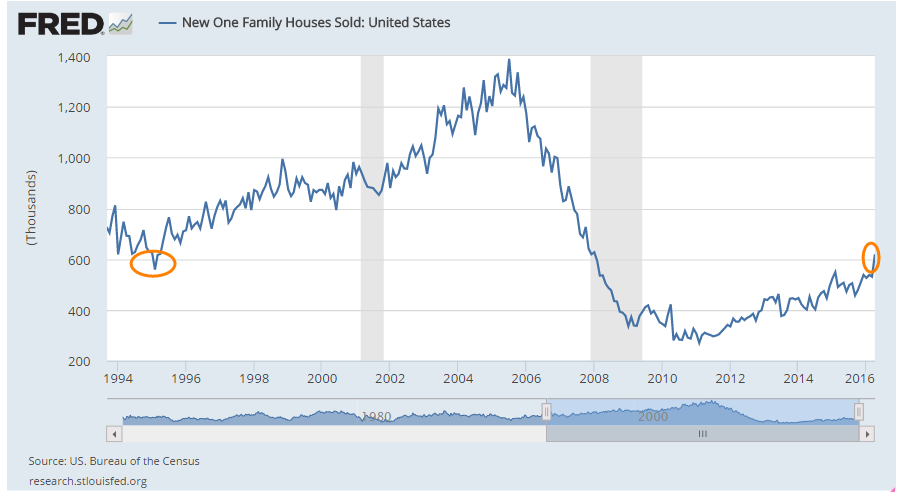
Several factors helped indexes recover in the latter part of the week. After dropping near $26 a barrel, oil rebounded above $30 at the end of the week.  Mario Draghi, head of the European Central Bank (ECB), indicated that the bank was prepared for additional stimulus.  Sales of existing homes climbed in December, indicating a level of confidence among U.S. families.

Since the first of the year, investors have withdrawn $26 billion from equity mutual funds and ETFs (Lipper), offsetting the $10 billion inflow into equities in the last week of 2015.  Fund giants Fidelity and Vanguard report that their customers have been net buyers of equities despite the turbulence.

Volatility (VIX or ^VIX at Yahoo Finance) in the last half of the week dropped to the 8 year average of about 22.  We have enjoyed such low volatility in the past few years (mid-teens) that investors are especially sensitive to price swings.  For a long term perspective, here is a chart showing some multi-year averages of volatility.

A few weeks ago, I noticed an acronym for the 2008 Global Financial Crisis – GFC.  The memory wound is still fresh for many. Older investors with their working years largely behind them may feel even more vulnerable in times of higher market volatility.

*******************************

Fund Fees

Employees in 401K plans may not know how much money they are paying in fees each year.  One of the charges is what is called a 12b-1 fee, and you will need to breathe slowly into a paper bag while you read about this one.  Each fund has an investment advisor to administer the fund’s investments and the fund pays a fee for this service.  In addition, under some plans, the advisor charges the fund holders a separate marketing and distribution fee, the so called 12b-1 charge, to promote the fund through sales materials or broker incentives.  Wait, you might ask.  Shouldn’t marketing expenses be part of the advisor’s fee? Well, you would think so.

The Annual Report that accompanies your 401K statement might list one of the funds you are invested in as “Blah-Blah-Blah Growth Fund, Class R-1,” hoping you are going to sleep.  The R-1 class means the fund is charging you 1% for marketing and distribution fees. Here is a glossary of the classes of mutual funds and the percentages of 12b-1 fees.  In addition, funds have  varying sales or redemption fees which are denoted by a letter class for the fund, i.e. Class A, B, C.  The Securities and Exchange Commission (SEC) explains these here.

The  SEC has a FAQ sheet explaining the various fees.  These charges might seem small but they add up over a working lifetime.  The SEC provides an example  of the 20% difference in value between a fund that charges 1.5% fee each year and one that charges .5%.  FINRA, the industry group that certifies and regulates financial planners, has a mutual fund expense calculator that enables an investor to compare fund expenses by their ticker symbols.

I compared an American Funds Class A Balanced Fund ABALX that might be found in a 401K with a Vangard Admiral Balanced Index Fund VBIAX over a ten year period.  Taking the default assumptions of a 5% return on an initial investment of $10K, I had $1670 more in the Vanguard fund after the ten year period, or an additional 3 years of return.

Some 401K plans make it more difficult to compare performance or fees.  They may list a fund whose ticker symbol is not listed on any exchange but is a “wrapper” for a fund that is listed.  The only way to find out that information would be to look at the prospectus or other materials for the 401K fund or visit the web site of the 401K plan administrator.  How likely are many participants to do that?  That’s the point.

Ugly January

January 17, 2016

The ever-strengthening dollar and growing inventories of crude led to a plunge in the price of a barrel of West Texas Intermediate (WTI) which fell below $30.  I remember hearing some analyst on Bloomberg about a year ago saying that oil prices could go as low as the $20 range.  HaHaHaHa!  A popular basket of oil stocks, XLE, is about half of it’s July 2014 price, falling 25% in the past two months and almost 10% in the two weeks. Here’s a tidbit from the latest Fact Set earnings brief: “On September 30, the estimated earnings decline for the Energy sector for Q1 2016 was -17.7%. Today, it stands at -56.1%.”  Ouch!

Volume in energy stocks this week was more than double the three month average.  It smells like capitulation, that point when a lot of investors have left the theater.  Investors who do believe that the theater is on fire, as it was in 2008, should probably stay away.

What the heck is going on?  This Business Insider article from June 2015 (yes, six months ago) explains and forecasts the money outflows from China and emerging markets.  Pay particular attention to #4. This Bloomberg article from this week confirms the capital flight from China as investors anticipate a further devaluing of the yuan.

4th quarter earnings reports will begin in earnest in the following week.  If there are disappointments, that will magnify the already negative sentiment.

**********************

Death Cross

No, it’s not the title of a Fellini movie.  The merits of technical analysis can be more controversial than a Republican Presidential debate, but here goes.   The 50 day average of the SP500 crossed above the 200 day average, a Golden Cross, at Christmas, then crossed back below the longer average this week, a Death Cross.  A Golden Cross is a positive sign of investor sentiment.  The Death Cross is self-explanatory.  A crossing above, then below, happens infrequently – very infrequently.  The last two times were in 1960 and 1969 and the following months were negative.  After January 1960, the market stayed relatively flat for a year.  In June 1969, it marked the beginning of an 18 month downturn.  There was an almost Golden Cross followed by a Death Cross in May 2002.  A similar 18 month downturn followed.

Longer term investors might use a 6 month short term average and an 18 month longer average, selling when the 6 month crosses below the 18 month, buying back in when the one month (or 6 month average in the case of more volatile sector ETFs) crosses back above the longer average. Like any trading system, one takes the risk of losing a small amount sometimes but avoids losing big.

Trading signals are infrequent using monthly average prices.  Note that the sharp downturn of the 1998 Asian financial crisis did not trigger a sell signal.  The six month average of the SP500 as a broad composite of investor sentiment is above the 18 month average but several sectors have been sells for several months: Emerging markets (June and July 2015), Energy stocks (January 2015), and European stocks (August 2015).  Industrials (XLI) have taken a beating this month and will probably give a sell signal at the end of the month.

John Bogle, founder of Vanguard, recommends that long term investors look at their statement once a year and rebalance to meet their target allocation, one that is suitable for their age, needs and tolerance for risk.  In that case, don’t look at your January statement.  As I wrote a few weeks ago, it could look ugly.

********************

CPI

In 1998, the Boskin Commission estimated that the Consumer Price Index (CPI) over-estimates the rate of inflation by an average of 1.1%. In 2000, the NBER (the agency that determines recessions) revised their methodology and their estimate of the over-statement to .65%.  In 2006, Robert Gordon, a member of the original committee, re-examined subsequent CPI data and the methods used by the committee.  His analysis re-asserted that the over-statement was at least 1%.

Although this academic debate might seem arcane, the implications are enormous, particularly in an election year.  Presidential contender Bernie Sanders is gaining momentum on Hillary Clinton (HRC) by repeatedly asserting that the inflation-adjusted incomes of working families have declined since 1973.  Although Mr. Sanders makes no proposals to stimulate economic growth, he has many redistribution plans to achieve economic justice.  If inflation has been overstated for the past few decades, then Mr. Sanders’ argument is logically weak but emotionally strong.  More importantly, neither side of the political aisle can even agree on a common set of facts.  The other side is not evil, or stupid, or disingenuous. The disagreement over methodology is legitimate and ongoing.

Ominosity

January 10, 2016

Happy New Year!

Wait, get rid of the exclamation point.

Happy New Year.

After this week!  What are you kidding me?!  Get rid of the Happy.

New Year.

Ok, that’s better.  The New Year was not so happy when the market started its first day of trading last Monday.  For the tenth consecutive month, manufacturing activity in China contracted, which weighed down commodities (DBC down over 4%), energy stocks (XLE down 7%), emerging markets (EEM down more than 8%) and the broader market, which was down 6%.  Even stocks (Johnson and Johnson, Coca-Cola) regarded as relatively safe dividend paying equities suffered losses of more than 3 or 4%.  Investors and traders were re-pricing future profits and dividends.

December’s powerful employment report buoyed the mood for a short time on Friday morning but traders soon turned their attention again to China and the broader market fell about 1% by day’s end.

Given the decline in stocks, one would guess that the price of bonds, hard hit during the past few weeks, had showed some strong gains.  TLT, a popular ETF for long term Treasuries, gained more than 2% during the week but remains range bound since last August.  Treasuries are a safe haven for risk averse money, but the prospect of rising interest rates mutes the attractiveness of long term bonds.

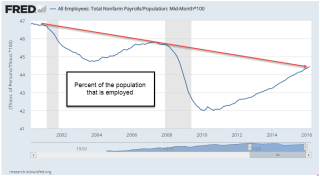
Growth in the core work force aged 25 – 54 remains strong, up over 1% from last year.  The number of people not in the labor force dropped by 277,000 from last month, a welcome sign.  However, we need to put aside the politics and look at this in a long term perspective.  For the past twenty years, through good times and bad, the number of people dropping out of the workforce each year has grown.

This demographic trend is more powerful than who is President, or which party runs the Congress.  Depending on our political preferences, we can attribute this 20 year trend to Clinton, Bush, Obama, Democrats or Republicans. The job of the good folks running for President this year will be to convince voters that their policies and prescriptions can overcome this trend.  Our job, as voters, is to believe them.

The Bureau of Labor Statistics recently released a report of a ten year comparison of the reasons why people have left the work force.  Based on this BLS analysis, a Bloomberg writer who had not done their homework mistakenly reported that there has been a dramatic increase in the number of 20-24 year olds who had retired.

This “statistic” points out a flaw in BLS and Census Bureau data. BLS data is partially based on the Current Population Survey, or CPS.  Interviewers are not allowed to follow up and challenge the responder.  Both the BLS and the Census Bureau have been aware of the problem for at least a decade but I don’t think anyone has proposed a solution that doesn’t present its own challenges.

Looking at Chart 3 of the BLS report, the percentage of retired 20-24 year olds was .2% in 2004, .6% in 2014. The number of retired 16-19 year olds was .2% in 2004 and .2% in 2014. Do we really believe that there are almost 200,000 retired 16-19 year olds in this country? See page 16 for the BLS discussion of this problem.

Now, let’s put ourselves in a similar situation.  We are 22 and have recently graduated from college and are having trouble finding a job that actually uses our education.  Because of this, we are staying at our parent’s home.  We answer our parent’s landline phone (Census Bureau is not allowed to call cell phones).  Somebody from the Census Bureau starts asking us questions.  In response to the question why we are not working, we are presented with several choices, one of which is that we are retired (see pages 16 and 17)  Sarcastically we answer that yeh, we are retired.  The questioner can probably tell by our tone of voice that we are being sarcastic but is required to simply record our response.  How valid is that response?

Understand that problems of self-reporting and questionnaire design underlie all of the data from the monthly Household Survey, including the unemployment rate. This gives those with strong political views an opportunity to claim that government statistics are part of a conspiracy.  Claims of conspiracies can not be disproved, which is why they are so persistent throughout human history.

Each year some research firms predict a global recession. Ominosity is the state of sounding ominous and this year is no different. Adam Hayes, a CFA writing at Investopedia, gives some good reasons  that he believes such a widespread recession is possible. All of these risks are present to some degree.

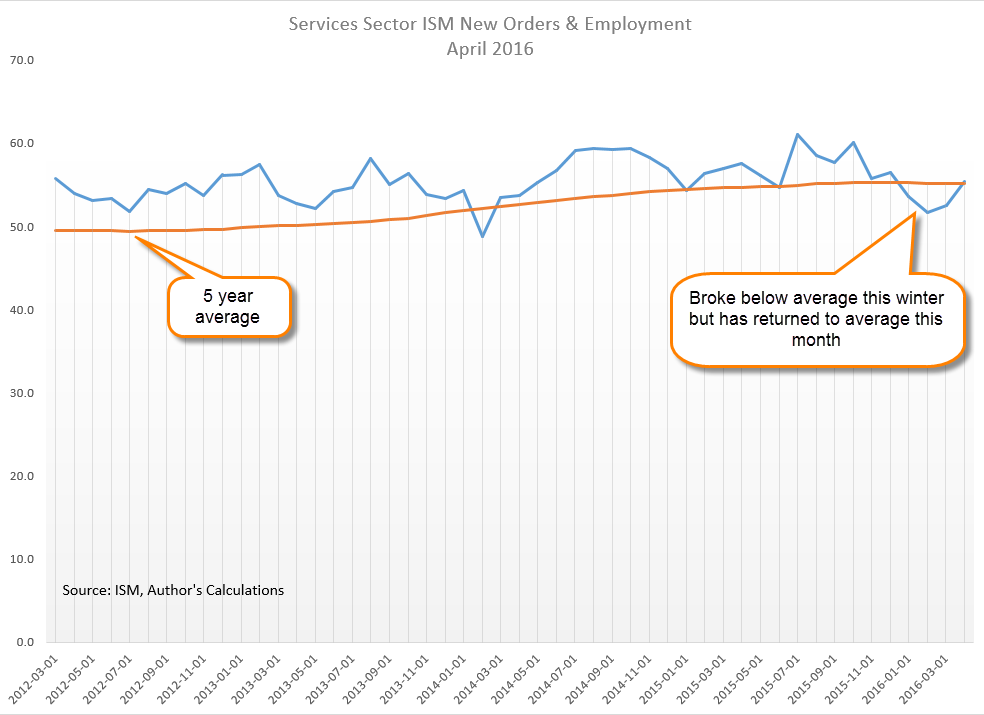
What makes me less convinced of a global recession is the strength of the U.S. economy.  Just as China “saved” the world during the financial crisis, the U.S. may play the role of the cavalry in this coming year. Let’s look at some key data from the recent ISM Purchasing Manager’s index.  This is the new orders and employment components of the services sectors which comprise 85% of the U.S. economy.  Growth remains strong.

Recessions are preceded by a drop in new orders and by a decline in employment.  When payroll growth less population growth is above 1%, as it is today, a recession is unlikely.

Let’s climb into our time machines and go forward just 11 months.  It is now December 2016 and the IMF has enough data to make a post-facto determination that the entire world’s economy went into recession in March 2016.  We look at the SP500 index.  Holy shit!  We climb into our time machines, go back to January 2016 and sell all of our stocks.  Missed that cliff.

What about bonds? Should we sell all those?  Darn it, we forgot to check interest rates and bond prices when we were ahead in the future.  Back into the time machine.  Go forward again.  U.S. Fed halted rate increases in March 2016, then lowered them a 1/4 point.  The ECB had kept interest rates negative in the Eurozone and bond prices have stayed relatively flat.  OK, cool.  We get back in our time machines and go back to January 2016 and decide to hold onto our bond index funds.  The interest on those is better than what we would get on a savings account and we know that we won’t suffer any capital losses on our investment during the year.

We take all the cash we have from selling our stocks and put them entirely in bonds.  Wait, could we make a better return in gold, or real estate?  Back in the time machine and back to the future!  But now we notice that the SP500 index in December 2016 is different.  So is the intermediate bond index.  What’s going on?  The future has changed.  Could it be the Higgs boson causing an abnormality in space-time?  Maybe there’s something wrong with our time machine.  But where can we find a mechanic who can diagnose and repair a time machine?  Suddenly the thought occurs to us that a lot of other investors have gone into the future in their time machines, then have returned to the present and bought and sold.  That, in turn, has changed the future.

The time machine is called the human brain.  Each day traders around the world make decisions based on their analytical and imaginative journeys into the future.  The Efficient Markets Hypothesis (EMH) formulated by Eugene Fama and others postulates that all those journeys and decisions essentially distill all the information available on any particular day.  Therefore, it is impossible to beat a broader market index of those decisions.

Behavioral Finance rests on the judgment that human beings are driven by fear and greed which causes investors to make mistakes in their appraisals of the future.  An understanding of the patterns of these inclinations can help someone take advantage of opportunities when there is a higher likelihood of asset mispricing.

Each year we read of those prognosticators who got it right.  Their time machine is working, we think, and we go with their predictions for the coming year.  Sometimes they get it right a second year.  Sometimes they don’t.  Abby Cohen is a famous example but there are many whose time machines work well for a while.  If I could figure a way to fix time machines, I could make a fortune.

New Year Review

January 3, 2016

As we begin 2016, let’s take a look at some trends.  It is often repeated that the recovery has been rather muted.  As former Presidential contender Herman Cain once said, “Blame Yourself!”  You and I are the problem.  We are not charging enough stuff or we are making too much money. Debt payments as a percent of after tax income are at an all time low.

At its 2007 peak, households spent 13% of their after tax income to service their debt.  Currently, it is about 10%. In early 2012, this ratio crossed below the recession levels of the early 1990s.  By the end of 2012, this debt service payment ratio had fallen even below the levels of the early 1980s.  Almost six years after the official end of the Great Recession the American people are behaving as though we are still in a recession.  An aging population is understandably more cautious with debt.  In addition to that demographic shift, middle aged and younger consumers are cautious after the financial crisis. We gorged on debt in the 1990s and 2000s and paid the price with two prolonged downturns.  Having learned our lessons, our overactive caution is now probably dragging down the economy.

In this election year, we can anticipate hearing that the sluggish economy can be blamed on: A) the Democratic President, or B) the Republican Congress.  It is Big Government’s fault.  It is the fault of greedy Big Companies.  Someone is to blame.  Pin the tail on the donkey.  Blah, blah, blah till we are sick of it.

************************

Auto Sales

The latest figures on auto sales show that we are near record levels of more than 18 million cars and light trucks sold, surpassed only by the auto sales of February 2000, just before the dot com boom fizzled out.  On a per capita basis, however, car sales are barely above average.  The thirty year average is .054 of a vehicle sold per person.  The current sales level is .056 of a car per person.  Automobile dealers would have to sell an addiitonal 900,000 cars and light trucks per year to have a historically strong sales year.

************************

Construction Spending

In some cities, housing prices and rents are rising, and vacancies are low.  We might assume that construction is booming throughout the country.  Six years into the recovery per capital construction spending is at 2004 levels and that does not account for inflation.  Levels like this are OK, not good, and certainly not booming.

*************************

Employment

The unemployment rate and average hourly wage may get most of the public’s attention but the Federal Reserve compiles an index of many indicators to judge the health of the labor market.  Positive changes in this index indicate an improving employment picture.  Negative changes may be temporary but can prompt the Fed to take what action it can to support the labor market.  Recent readings are mildly positive but certainly not strong.

*************************

Stock Market

Many of the companies in the SP500 generate half of their revenue overseas.  Because of the continuing strength of the dollar, the profits from those foreign sales are reduced when exchanged for dollars.  According to Fact Set, earnings for the SP500 are projected to be about $127 per share, the same level as mid-2014.  In the third quarter of 2015, the majority of companies reported revenue below estimates.  As 4th quarter revenue and earnings are released in the coming weeks, investors will be especially vigilant for any downturns in sales as well as revisions to sales estimates for the coming year.  It could get bloody.

The Other Book

December 27, 2015

Here’s hoping everyone had a good Christmas.

Investors use several different metrics to judge the value of a company.  Probably the most common is the Price to Earnings, or P/E, ratio.  This is the stock’s price divided by the earnings per share that the company has generated over the past twelve months.

Another common measure is the Price to Sales (P/S) ratio: the stock price divided by the Revenue per Share.  A third yardstick is the Price to Book (P/B) ratio, the stock price divided by the Book Value per Share.  What is book value?  Subract the debt of a company from its assets and what is left is the book value of the company.  If a company were to be liquidated, the shareholders get everything that belongs to the company after the creditors are paid off.  Book value does not include intangible assets like intellectual property and the power of a well-known brand, sometimes referred to as “blue sky.”

Some investors may argue that book value understates the true value of a company because it ignores these vague assets.  A value investor, on the other hand, might counter that the intangible value of a brand can dwindle rapidly in a highly competitive and rapidly changing environment.  As an example, remember Palm?  Don’t know who or what that is?  In the 1990s, there was a lot of blue sky baked into market valuations that dissipated quickly as investors regained their senses.

Even long time retail stalwarts like Sears have learned that brand is sand, eroding under the relentless pounding of shifting tastes, technologies and  competition.

Combining the P/S and P/B ratio – a mashup, so to speak – is the S/B ratio, the Sales to Book ratio, and is sometimes called the Buffet indicator, after Warren Buffet, a well known value investor.   While this ratio may not appear in the key valuation ratios for a company, it is derived easily by dividing the P/B ratio by the P/S ratio.

Let’s look at two examples in the same industry.  Apple has a P/S ratio of 2.59 and a P/B ratio of 5.08.  Using simple math we get an S/B ratio of 5.08 / 2.59 which we round off to 2.  Microsoft has a P/S ratio fo 4.91 and a P/B ratio of 5.76, giving us an S/B ratio of 5.76 / 4.91, or approximately 1.2.

The difference between those two ratios, 2.0 for Apple and 1.2 for Microsoft, tells us that the market values Apple’s blue sky a lot more than it does Microsoft.  Fifteen years ago, the situtation was reversed.  This was before the introduction of  the iPod, the iPhone and iPad.  Apple’s brand has become the dominant force in the consumer technology market.

Using the book value of all companies we can construct a ratio that tells us the relative richness of asset valuations.  We will flip the S/B ratio used with individual companies and substitute GDP, the economic activity of a nation, for sales or revenue.

Here is a decades long chart of that indicator.  Higher interest rates and inflation in the late 1960s and 1970s helped lower this ratio.  By the early part of the 1980s stock valuations, using this method, were so beaten up that they had nowhere to go but up.  Lower interest rates and an  explosion of technological innovation in the past few decades have contributed to the rise in this indicator.  It wasn’t until about 1995 that the ratio was an even 1.0.

To the value investor, the ratio and the direction of changes in the ratio are equally important.  How much blue sky is baked into current market valuations? Is the ratio rising or falling?  Has the market overpriced the future value of the corporate blue sky?  If so, future price gains may be muted as investors correct their valuations.  Like 2011, the SP500 index will probably show little gain or loss this year.  Here’s a closer look at recent years.  The ratio is falling but still above 1.0.

*******************
 New Year’s Resolutions

Readers who are looking for one more resolution to add to their list can try this one: remembering stuff using spaced repetition with Anki Flashcards.  The desktop app is free and there are a number of shared decks of flashcards available for download.  In no time, you’ll be able to remember your wedding anniversary.  You’ll be able to retrieve French or Spanish phrases stored in some dark corner of your brain along with the lyrics to a 1980s Devo song.  Anything is possible.  Who was the actress who played Princess Leia?  Easy.  Who was the director of the movie Touch of Evil?  Oooh, repeat that one again.

Year End Approaches

December 19, 2015

For those of you who pay attention to crossing averages, the 50 day average of the SP500 index just crossed above the 200 day average.  This long term buy signal is often referred to as the Golden Cross.  The Death Cross, when the 50 crossed below the 200 day average in early August, is a sell signal.  Those who sold some of their holdings at that time missed the volatility of the past few months.  The index was at 2100 in early August.  It closed at approximately 2000 on Friday.  The index has lost about 4% in the past two days.

Past buy crosses were June 2009, October 2010, January and August 2012 and this past week.  Recent sell crosses were December 2007, July 2010, August 2011, July 2012, and August 2015.

In buy, sell order they were December 2007 (sell), June 2009 (buy), July 2010 (sell), October 2010 (buy), August 2011 (sell), January 2012 (buy), July 2012 (sell), August 2012 (buy), August 2015 (sell) and December 2015 (buy).  Note the three year period between buy and sell signals from August 2012 to August 2015.  The market gained 55% during that period.

As you can see from the list above, the market usually regains its footing after a few months – except when it doesn’t, as in 2008.  This buy sell rule avoided the protracted market downturns in 2000 and 2008 at the expense of acting on signals that are false positives, or what is known in statistics as Type I errors.

*****************************

Cost Basis

Mutual fund companies typically calculate an investor’s cost basis for their funds.  Some investors mistakenly think that cost basis reflects the performance of their investment.  It doesn’t. Let’s look at an example of a cost basis entry:

At first glance, an investor might think they have lost $186 since they first started investing in the fund.  Usually, that’s not the case.  In this case, the fund has earned more than $5000 in ten years.

Let’s look at some basics.  An investor in a mutual fund has the option of having dividends and capital gains reinvested in the same fund or transferred to another fund like a money market.  To begin our simple example, let’s choose to NOT reinvest.

Let’s say an investor put $1000 in a bond fund BONDX.  Each share sells for $100 so they have bought 10 shares.  Every quarter the fund pays a $1 dividend per share.  A day before the dividend is paid the fund’s share price is $101.  The fund then distributes the $1 dividend.  The market value of each share instantly falls by the amount of the dividend – $1 – so that after the dividend the market value of each share of BONDX is $100.  What is the investor’s cost basis?  $1000.  The market value is 10 shares x $100 = $1000.  Capital gain or loss? $0.  Does this mean the investor has made no money?  No, they have an extra 10 shares x $1 dividend per share = $10 in their money market account.

When opening up a fund the default option may be to reinvest capital gains and dividends.  This is where some investors get confused.  So, let’s change the reinvest option and choose YES. Now, as before, the fund distributes the $1 dividend and the share price of the fund falls to $100, just as before.  Now, however, the money is not transferred to the money market fund.  Instead it is used to buy more shares of BONDX.  The $10 that the investor receives buy a 1/10 share of BONDX.  Now the investor owns 10.1 shares of BONDX at a cost of $100 per share = $1010 cost basis.  The market price of the fund is $100 per share x 10.1 shares = $1010.  Captial gain or loss: $0.  Again, the capital gain or loss does not reflect the total performance, or profit and loss, of the investment.  The profit is $10.

So, the capital gain or loss should be used only to calculate the tax effect of selling a fund, not the performance of the fund.  The fund company will calculate the performance, or the rate of return (IRR) on an investor’s funds on a separate screen.  Choose that option instead of the cost basis screen.

******************************

The Investment Cycle

Investments tend to rise and fall in price over the course of a business cycle.  At the end of an expansionary cycle, commodity prices start falling.  Yardeni Research has some good graphs which illustrate the ongoing plunge in commodity prices.

As the economy begins its contraction phase, the prices of bonds start to fall.  As we enter recession or at least a contraction of growth, stocks fall.  In the recovery, comodities rise first, followed by bonds, then stocks.  Here is more information for readers who are interested in exploring the details and background of this cycle.

***************************
Diabetes

The American Diabetes Assn puts the direct costs of treating diabetes at $150 billion.  That is 25% of the $600 billion spent on Medicare in 2014.  Indirect costs add another $75 billion in costs.  Much of the increased expenditure is for treating late onset Type II diabetes.  Expenses are sure to grow as the population ages and people do not make the life style changes needed to delay or moderate the onset of the disease.

***************************
Credit Spreads

Several weeks ago, I noted the growing “spread” between Treasury bonds and high yield junk bonds.    The graph I showed was the benchmark of junk bonds, the Master II class. Let’s call them Bench Junks. The bottom of the barrel, so to speak, are those company bonds rated CCC and lower.  These are companies that are more likely to default as economic growth slows or contracts. Let’s call them Low Junks. While the Bench Junks’ spread shows investor concern, the Low Junks’ spread shows a stampede out of these riskier bonds.  A rising spread means that the prices for those bonds are falling, effectively giving buyers a higher interest rate. Investors want the higher yield to compensate them for the higher risk of owning the bonds.

Here is an article explaining the composition of some high yield bond ETFs for those readers who are interested. in learning more.

**************************

Income Taxes

Turbo Tax may be the most widely used individual income tax software but there are many providers of tax software.  Each state usually lists the software programs it has approved.  You can Google “approved income tax software” and insert your state name at the beginning of the search term. Here is a link to Colorado‘s list of approved software.  Here is the list for Texas, New York and California.

**************************
Lastly, have a wonderful Christmas!

Risky Biz

December 13, 2015

How low can crude oil prices go?  Older readers may remember the Limbo, a party dance popular in the early 60s.  After breaking through the “limbo stick” of $40 per barrel, gas prices sank even lower when the IEA indicated that the supply glut will continue through 2016 (Story).

A popular energy ETF, XLE, has fallen 11% in nine trading days.  Yes, an entire sector of the economy has lost more than 1% per day this month. Some oil service companies lost more than 3% on Friday alone. The large integrated oil companies like Exxon (XOM) and Chevron (CVX) say they are committed to maintaining their dividends (Exxon now near 4%, Chevron near 5%) but investors are concerned that continuing price pressures will make that ever more difficult. This article provides a good overview of the structure, revenue and profit streams of large integrated oil companies.

So we lie around at night worried about our stock portfolio.  Why would we do that?  Because someone – who? – is going to pay us a little extra to worry about our stocks.  Or, at least, that’s the way it’s supposed to go, isn’t it? The extra return we are supposed to get for our worries is called a risk premium, or the plural – premia.  One measure of that premium is the total return on stocks minus the total return on a safe long term bond like a ten year Treasury bond.

In his book Expected Returns, An Investor’s Guide to Harvesting Market Reward,  Antti Ilmanen reviews the historical returns of several types of assets during the past century. He wrote a free summary of the book in 2012 (Kindle version  OR PDF version).  Mr Ilmanen presents an investing cube (pg. 3) as a visualization of the factors or choices that an investor must consider.   On one face are assets categorized into four types of investment.  On another face are four styles of investment.  On the third face of the cube are four types of risk.

A surprising find was that the risk premia of stocks over bonds was only 2.38% (p. 12) during the past fifty years.  Investors are not being paid much for their worry.  When the author compared the returns on stocks to longer term twenty year Treasury bonds (an ETF like TLT, for example), the risk premium has been negative for the past forty years.

The author emphasizes that “a key theme in this book is the crucial distinction between realized (ex post) average excess returns and expected (ex ante) risk premia.” (p. 15)  Historical averages of risk premia may be exaggerated by high inflation, which hurt the returns on bonds in the 1970s and part of the 1980s, and made returns on stocks that much better by comparison.  In a low inflation environment such as the one we have now the risk premia for owning stocks may be rather muted.

Ilmanen’s analysis of past returns reveals several historical trends that can help an investor’s portfolio.    Value investing tends to produce higher returns over time.  So-called Dividend stocks also generate additional return.

I was surprised at the relative stability of per capita GDP growth over 100 years.  We wring our hands in response to a crisis like the dot-com meltdown or the Great Recession but these horrific events barely show in the average aggregate output of the country over a person’s working years. Here is a table from the PDF summary.

A mutual fund QSPIX was formed last year based partly on the research in the book.  However, the minimum investment is $5,000,000.    The fund is currently 28% in cash.

*********************************

Social Security Strategies

A resource on the right side of this blog is Maximize My Social Security (MMSS), a personally tailored – and inexpensive – advisory service to guide older people to better informed Social Security choices.  The site does not use your social security number.  If you already have an online account with the Social Security Administration, you can complete the forms at MMSS and get some results in under twenty minutes.

Old people who used to talk about the latest Pink Floyd or Led Zep album when they were younger now talk about Social Security, Medicare and their aches and pains.  Always a popular topic:  hey, what do you think about waiting to file for Social Security?

Pros of waiting:

1.  Where else  can any of us earn a guaranteed 8% on our money each year?  Sign me up!  For each year we wait, our Social Security annual benefit increases by 8%.

2. Inflation adjusted:  On top of the additional 32% we get from SS when we start collecting SS at age 70, we are getting an inflation adjustment on that higher amount.

3.  If we need to borrow money to get by during the 4 years we wait, we may be able to borrow the money using our house as collateral.  Depending on our tax circumstances, the interest we pay on the borrowed money could be deductible, reducing the net cost of borrowing.

4.  If we are a guy, we will probably die before our spouse.  Wives who may have a lower benefit will get their benefit amount bumped up to what we were receiving.

Cons of waiting:

1.  We could die before the “payoff” age, between 79 and 82.  This is the age when the inflation adjusted benefits we receive by delaying our benefit matches the total we would have collected by claiming at an earlier age.  However, we often don’t factor in the advantage of the #4 Pro above in which our spouse collects a higher amount till her death.

2.  Congress could change SS payments and rules.  The institution does not have a good track record for keeping its promises.  The swelling ranks of the Boomer generation contributed far more than recipients of earlier generations took out in benefits. Congresses of the past few decades have spent all the extra money accumulated in the Social Security coffers.  After 2020 the system will come under greater cash flow pressure as the Boomers continue to retire and claim benefits.  If Congress does reduce benefits,  then those of us who waited to file for benefits will probably regret our decision.  By the way, MMSS allows users to estimate the long term impact of such a reduction.

3.  We may have to borrow to make ends meet while we wait to collect benefits.  Banks don’t usually loan money to retirees with no job income, necessitating some asset-backed mortgage. Older people may be averse to assuming any new debt.

4.  Withdrawing money from savings while we wait will reduce our savings for a time, which will lessen the “endowment” base of our lifetime wealth.  While the additional 8% per year from SS should more than offset that loss, we can never be certain.  As an example, let’s imagine a retiree at the beginning of 1995 who decided to draw down savings and wait four years to start collecting SS benefits.  The stock market had gone nowhere during 1994.  She sold some stocks and bought a 4 year CD “ladder” for the amount she would need to tide her over till she started collecting benefits.  During those next four years, the SP500 index rose from 459 to 1229, a 167% gain – more than 25% annually excluding dividends.  Even with the additional money our retiree was making each month in SS benefits because of her decision to delay, it was the worst time to get out of the stock market!

A Change Is Gonna Come

December 6, 2015

A horrible week for many families.  When we count the dead and injured in mass shootings, we often neglect to include the family and friends of each of these victims.  If we conservatively estimate 20 – 30 people affected for each victim, we can better appreciate the emotional and economic impact of these events. Shooting Tracker lists the daily mass shootings (involving four or more victims) in the U.S. in 2015.  What surprised me is that, in most cases, the shooter/assailant is unknown.

A strong November jobs report sent equities, gold and bonds soaring higher on Friday.  Markets reacted negatively on Thursday following a lackluster response from the European Central Bank(ECB) and comments by Fed chair Janet Yellen indicating that a small rate increase was in the cards at the mid-December Fed meeting.  The SP500 closed Thurday evening below November’s close.  Not just the close of November 2015, but also the monthly close of November 2014!

Overnight (early Friday morning in the U.S.), the ECB said that they would do whatever it took to support the European economy. Shortly after the cock crowed in Des Moines, the Bureau of Labor Statistics released November’s labor report, confirming an earlier ADP report of private job gains.  By the end of trading on Friday, the SP500 had jumped up 2%.  However, it  is important to step back and gain a longer term perspective.  The index is still slightly below February 2015’s close – and May’s close – and July’s close.

Extended periods of price stability – let’s call them EPPS – are infrequent.  Markets struggle constantly to find a balance of asset valuation. Optimists (bulls) pull on one end of the valuation rope.  Pessimists (bears) pull on the other end.  Every once or twice in a decade, neither bears nor bulls have a commanding influence and prices stabilize. Markets can go up or down after these leveling periods: 1976 (down), 1983 (up),  1994 (up), 2000 (down), 2007 (down), 2015 (?)

**************************

Year End Planning

Mutual funds must pass on their capital gains and losses to investors.  Investors who have mutual funds that are not in a tax-sheltered retirement account should take the time in early December to check on pending capital gains distributions either with their tax advisor or do it themselves.  Most mutual fund companies distribute gains in mid to late December.  Your mutual fund will have a list of pending December distributions on their web site.  For those retail investors in a rush, you might just scan through the list and look for those funds that have a distribution that is 5% or more of the value of the fund, then look and see if it is one of your funds.

An EPPS tends to produce relatively small capital gains but this year some mid-cap growth funds and international funds may be declaring gains of 7 – 10% of the value of the fund.  An investor who had $50,000 in some mid-cap growth fund might see a capital gain distribution of $4,000 on their December statement.  When an investor receives the statement in January 2016, it is too late to offset this gain with a loss.  Depending on the taxpayer’s marginal tax rate, they could be on the hook to the tax man for $700 – $1200.

Let’s say an investor is anticipating a $4000 capital gain distribution in a taxable mutual fund in late December.  Most mutual fund companies list the cost basis of each fund in an investor’s account. An investor who had a cost basis that was higher than the current value of the fund could sell some shares in that fund to offset some or all of the capital gain distribution in the other fund.  This is called tax loss harvesting.  Again, remind or ask your tax advisor if you are unclear on this.

Here is an IRS FAQ sheet on capital gains and losses.  Here is an article on the various combinations of short term and long term gains and losses.

**************************
CWPI

The latest ISM Survey of Purchasing Managers (PMI) showed that the manufacturing sector of the economy contracted in November.  October’s reading was neutral at 50.1.  November’s reading was 48.6.

The services sector, which is most of the economy, is still growing strongly.  Both new orders and employment are showing robust growth.   

However, manufacturing inventories have contracted for five months in a row.  For now, this decline is more than offset by inventory growth in the service industries.  However, the drag from the manufacturing sector is affecting the services sector.  The trough and peak pattern of growth in employment and new orders since the recession recovery in 2009 has begun to get a bit erratic.  Nothing to get too concerned about but something to watch.

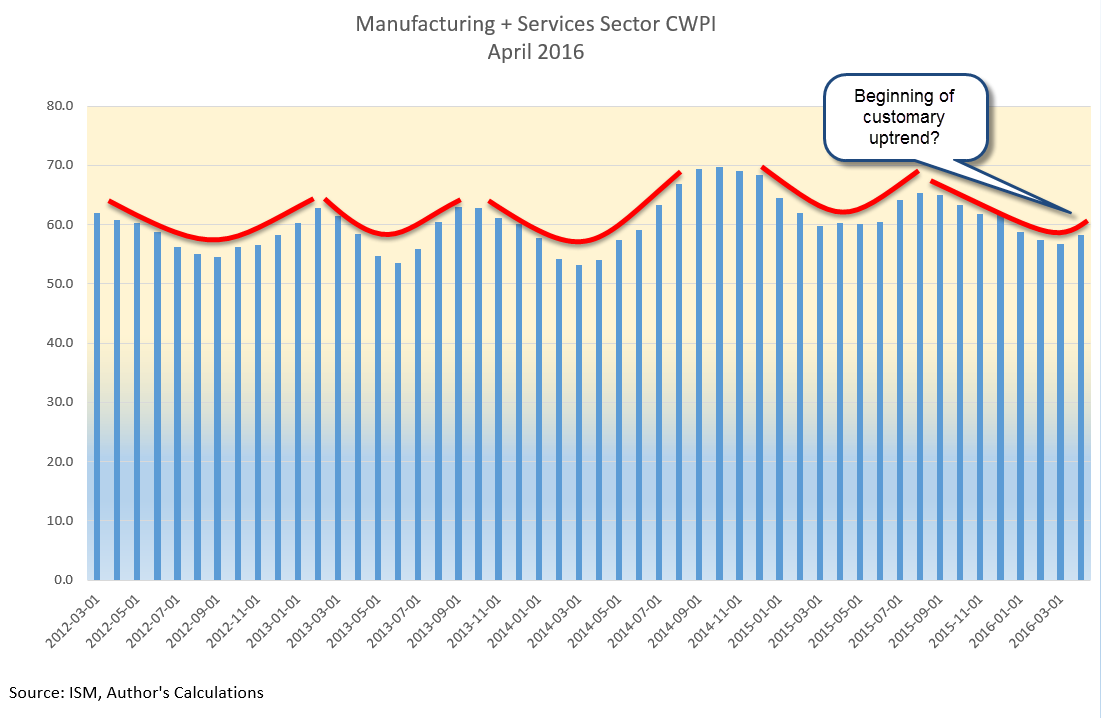
The Constant Weighted Purchasing Index combines the manufacturing and service surveys and weights the various components, giving more weight to New Orders and Employment.  Both components anticipate future conditions a bit better than the equal weight methodology used by ISM, which conducts the surveys.  In addition, there is a smoothing calculation for the CWPI.

During this six year recovery, the CWPI has shown a wave-like pattern of growth.  Since the summer of 2014, growth has remained strong but there has been a leveling in the pattern as the manufacturing sector no longer contributes to the peaks of growth.

Despite the underlying growth fundamentals, there are some troubling signs.  In response to activist investors, to boost earnings numbers and maintain dividend levels, companies have bought back shares in their own company at an unprecedented level.  In some cases, companies are taking advantage of low interest rates to borrow money to make the share buybacks. (U.S. Now Spend More on Buybacks Than Factories, WSJ 5/27/15)

*******************************

Labor Report

46,000 jobs gained in construction was a highlight of November’s labor report and was about a fifth of all job gains.  Rarely do gains in construction outweigh gains in professional services or health care. This is more than twice the 21,000 average gains of the past year. The steady but slow growth in construction jobs is heartening but a long term perspective shows just how weak this sector is.

Involuntary part-timers, however, increased by more than 300,000 this past month, wiping out a quarter of the improvement over the past year.  These employees, who are working part time because they can not find full time work, have decreased by almost 800,000 over the past year.

The core work force, those aged 25-54, remains strong with annual growth above 1%.

Other notable negatives in this report are the lack of wage growth and hours worked.  Wage growth for all employees is a respectable 2.3% annual rate, but only 1.7% for production and non-supervisory employees.  This is below the core rate of inflation so that the income of ordinary workers is not keeping up with the increase in prices of the goods they buy.

Hours worked per week has declined one tenth of an hour in the past year, not heartening news at this point in what is supposed to be a recovery.  Overtime hours in the manufacturing sector has dropped 10% in the past year.

******************************

Inflation

The core CPI is a measure of inflation that excludes the more volatile price changes of food  and energy.  While the headline CPI gets the attention, this alternative measure is one that the Federal Reserve looks at to get a sense of the underlying inflationary forces in the economy.  The target annual rate that the Fed uses is 2%.

October’s annual rate was 1.9%.  November’s rate won’t be released till mid-December. However, Ms. Yellen made it pretty clear that the Fed will raise interest rates this month, the first time since the financial crisis. I suspect that prelimary reports to the Fed on November’s reading showed no decline in this core rate.  With employment gains and inflation stable, the FOMC probably felt comfortable with a small uptick in the bench mark rate.

Heatlh Care

November 29, 2015

Obamacare

United Healthcare (UNH), the largest health insurance carrier in the U.S., announced that they may drop out of the state health care exchanges at the end of 2016.  The CEO indicated that it would review costs again in mid-2016 but was concerned that continuing losses on the state exchange plans would simply make it uneconomical for UNH to continue to offer these plans.

UNH says it has evidence of many individuals gaming the system by coming into and out of the health insurance system when they need medical services. {Bloomberg and Market Watch} It is not clear how patients would do this since the health care exchanges have enrollment rules similar to Medicare.  These restrictions are designed to make it difficult for individuals to game the system.  Are those rules being implemented consistently on the state level?  If the policy rules are in place, have the screening algorithms been reviewed?  Poor implementation and oversight have plagued some exchanges.

At the heart of Obamacare is the projection that costs for the newly insured stabilize after approximately two years, a metric derived from long experience with Medicare patients.  Individuals who have not had regular medical care often have chronic unattended conditions which need to be stabilized.  Medicare costs typically rise during this initial stage before leveling off.

Obamacare will certainly be an issue in the upcoming Presidential election.  The debate will intensify if other insurers express doubts about the economic feasibility of the system,

************************

Productivity and Policy

Economists and policy makers continue to debate the causes, and solutions, for the slowdown in labor productivity that has occurred over the past several decades.  Larry Summers served as Treasury Secretary under President Clinton, Director of the National Economic Council under President Obama, and Chief Economist at the World Bank.  In other words, the guy’s got some chops.

In a recent speech Summers noted several trends:

1)  Dis-employment of unskilled workers.  The participation rate of those aged 25 – 54 has declined from 95% in 1965 to 85% now. (p. 3)  While this is often attributed to technical improvements, Mr. Summers makes the case that labor productivity should go up, not down, due to technical change.  That is not the case.  Summers says he doesn’t have the answer either but the contradiction between theory and data indicates that economists still don’t understand the underlying processes. (p. 4)

2) Mismeasurement.  Productivity measures are based on the calculation of real GDP which is dependent on the measure of inflation.  Summers asks whether differences in quality, or what are called hedonic measures, are captured in CPI data.  He asks “Which would you rather have for you and your family, 1980 healthcare at 1980 prices or 2015 healthcare at 2015 prices?  How many people would prefer 2015 healthcare at 2015 prices?”  If people prefer the 2015 variety at 2015 prices then inflation has been negative in healthcare.  As a percent of GDP, healthcare spending has increased.  Mismeasuring inflation in healthcare may negate all or most of this increase. (p. 5)

3) As we have transitioned to an economy dominated by services, mismeasurement of inflation has probably increased.  A leading technocat in Democratic administrations, Summers casts doubts on a staple of liberal rhetoric – that median family income has not changed since 1973.  This idea is a central tenet of Bernie Sanders presidential campaign.  What if the measurement of median family income is flawed?  This doubt is more often raised by conservative economists and policy makers.  Summers’ remarks crossed the ideological and political divide and surely raised a few eyebrows. (p. 6)

4) Developing the theme of measurement as it pertains to different types of economies, Summers refers to several statistical terms like “unit root” stationarity that may challenge casual readers.

When a time series (data observations over time like GDP) has a unit root it exhibits more deterministic behavior; it is more likely to adopt an altered path or trendline when shocked off its previous path.

Series without a unit root are more likely to exhibit stochastic behavior when subjected to some shock; that is, they will tend to return to their former path or trendline, not form a new trendline.

At mid-century, when our economy was much more reliant on manufacturing, it behaved in a stochastic way when subjected to economic shocks.  It rebounded to a previous trendline.  Our economy is now overwhelmingly service oriented, about 88%.  Summers makes the case (p. 9) that unbalanced economies like ours behave differently than a more balanced economy.  The growth path of GDP changes permanently in response to an economic shock like the financial crisis of 2008.  If that is the case, policy changes will be ineffective in returning GDP and employment back to the former trendline. (For more info on testing the deterministic and stochastic components of time series processes, see this).

Summers adds to the number of voices calling for a more accurate – but also objective – measurement of inflation. Poor measurement leads to imprecise data leads to inaccurate conclusions leads to ineffective policy leads to more problems leads to…

Policy debates often involve complicated issues of identification, measurement, and methods of analysis that are not readily explainable in a campaign speech.  On our way home from work, a complicated system of algorithms based on traffic data determines whether the traffic lights continue to trip green as we maintain a constant speed.  Much of this is hidden from us and incomprehensible to most of us.  All of that complexity is boiled down to a simple heuristic: we go when it’s green, stop when it’s red.

Voters like simple.  The job of a politician is to convince voters and donors that if they are elected, they will implement the right policies, the correct algorithms that will move traffic, i.e. the economic fortunes of the families of America, faster.

Credit Spreads

November 22, 2015

The behavior of bonds, their pricing and their yields (the interest or return on the bond), can seem like a mystery to many casual investors.  As this Money magazine writer notes, the language is backwards.  Yields rise but that’s bad because prices are falling.  Prices rise but that’s bad for new buyers who are getting a low yield on their investment.   The article mentions a little trick to help keep it straight – convert the yield to a P/E ratio, something more familiar to many investors.

In Montana, a “spread” might be a large ranch but on Wall Street the term often refers to the difference in yield between a safe investment like a 10 year Treasury bond and an index of lower rated corporate bonds, or “junk” bonds. Investors want to be paid for the extra risk they are taking.  As investors get more worried about the economy and the growth of profits, they worry about the ability of some companies to pay their debts.  Debts are paid from profits.  Less profit or no profit increases the chance of default.

Some call the spread a “risk premium,” and when that premium is less than 5 – 6%, it indicates a relatively low to moderate sense of worry among investors.  Anything greater than 6% is a note of caution.  In the chart below a rising spread above 6% often signals the coming of stock market swoons.  When I pulled this chart earlier in the week, the rate was 6.19%.  On Friday, the rate was climbing toward 6.3%.

This 2004 paper from the research division of the Federal Reserve gives a bit more depth on credit spreads and their movements.

*********************************

Inventory-To-Sales Ratio

In a September blog post I noted the elevated inventory to sales ratio, meaning that manufacturers, merchants and wholesalers had too much product on hand relative to the amount of sales.  There is a bit of lag in this series; September’s figures were released only a week ago.  At 1.38, the ratio continues to climb.

*******************************

The Social Security Annuity

In the blog links to the right is an article by Wade Pfau comparing the “annuity” that Social Security provides with those available on the commercial market.  He also analyzes the extra return one can achieve by delaying Social Security until age 70.